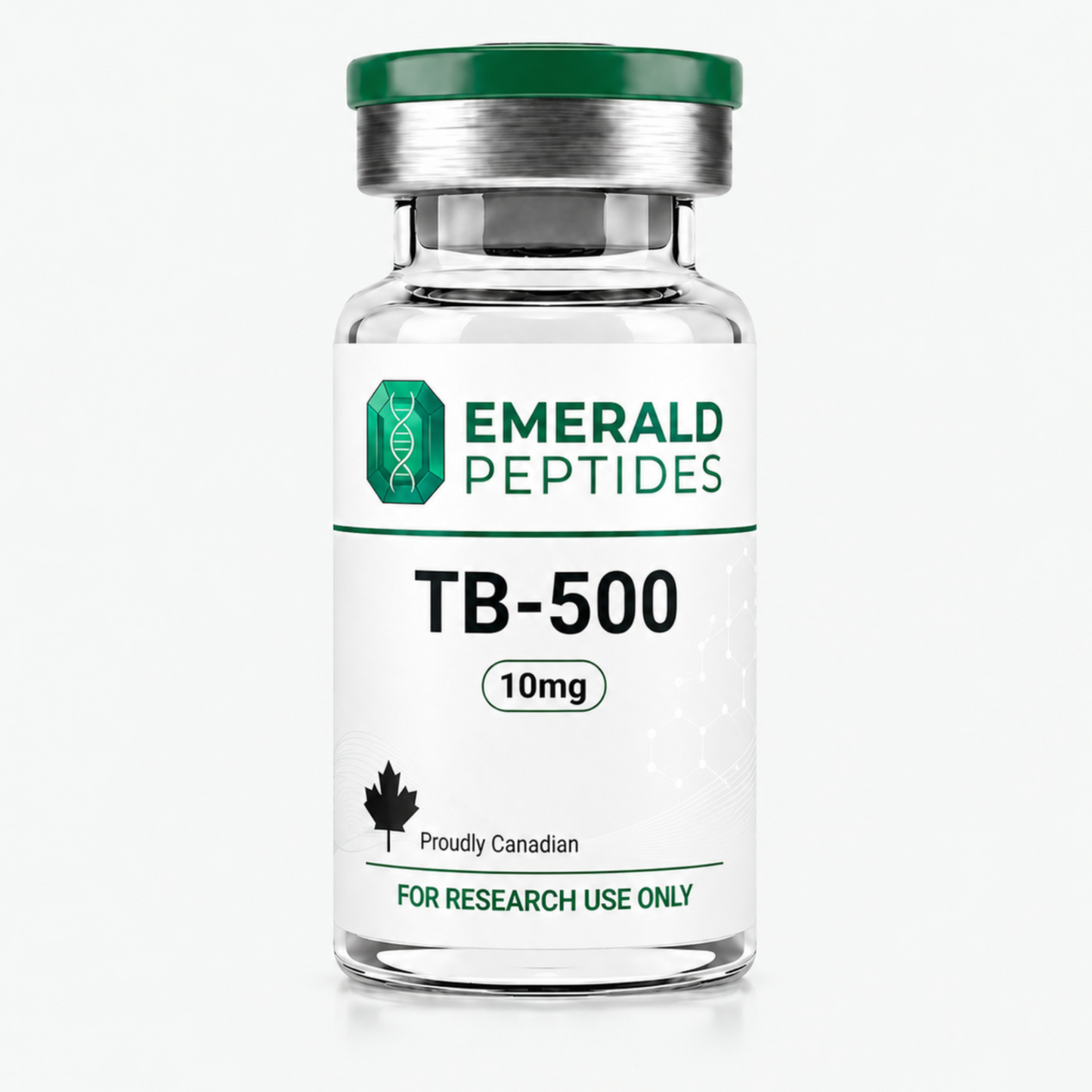
TB-500
TB-500
In stock
929 units sold
- Lab Tested for Purity & Quality
- Fast & Secure Shipping
 Manufactured in Canada


Buy TB500 Peptides — Synthetic Thymosin β-4
TB500 peptides from Emerald Peptides supply research-grade synthetic thymosin β-4 for cellular migration, angiogenesis, and cardiac repair research designs. TB-500 is a synthetic version of the full 43-amino-acid thymosin β-4, endogenous to most mammalian cell types and one of the most extensively studied actin-binding peptides in molecular biology. Originally characterized by Allan Goldstein and colleagues in 1981, TB-500 has become a standard reference compound across cardiac repair, wound healing, and dermal regeneration research. Each TB500 vial ships at ≥99% HPLC purity with mass-spec-verified identity, batch-specific certificate of analysis, and fast domestic Canadian shipping.
Product Details
- Form: Lyophilized peptide
- Net per vial: 10 mg (filled to approximately 104% of label)
- Purity: ≥99% (HPLC-verified)
- Identity: MS-verified (per COA)
- Storage: 2–8 °C, protect from light
- Formula / M.W.: C₂₁₂H₃₅₀N₅₆O₇₈S / 4963.44 Da
- CAS: 77591-33-4
What Makes TB-500 a Unique Compound
Thymosin β-4 was first isolated from calf thymic tissue in 1981 by Allan Goldstein and colleagues, with subsequent decades of research expanding its role beyond the immune system to include broad tissue-repair and cytoskeletal-regulation functions. The synthetic 43-amino-acid form, popularized as TB-500 in research and veterinary contexts, became a standard tool for groups studying actin dynamics in vivo.
What distinguishes TB-500 from other repair-focused peptides is its mechanistic specificity. By acting as the principal G-actin sequestering peptide, it provides researchers with a defined molecular handle on cytoskeletal organization — a starting point for downstream investigation of cell migration, angiogenic transcriptional programs, and tissue regeneration. Its activity across endothelial, fibroblast, keratinocyte, and cardiomyocyte systems makes it one of the few peptide tools relevant across multiple parallel research domains.
Key Benefits
- Cellular Migration & Wound Repair — Published in vitro and rodent studies report accelerated keratinocyte migration, fibroblast recruitment, and re-epithelialization kinetics in TB-500-treated wound models, with mechanistic work linking effects to G-actin sequestration.
- Angiogenesis & Vascular Remodeling — Animal models have documented increased capillary density and endothelial cell organization in dermal and cardiac tissue, supporting investigation into TB-500's role in vascularization research.
- Cardiac Tissue Models — Preclinical studies in murine ischemia-reperfusion models have reported reduced infarct size and improved cardiomyocyte survival, generating sustained interest in TB-500 as a tool peptide for cardiac repair research.
- Skeletal Muscle & Soft Tissue Repair — Published rodent injury models, including muscle crush and tendon laceration designs, describe accelerated recovery markers and improved tissue organization in treated cohorts.
- Anti-Inflammatory Modulation — Cell-based and animal studies have measured reductions in inflammatory cytokine expression and modulation of NF-κB signaling, framing TB-500 as a candidate for investigation into inflammation-coupled tissue repair.
Related Peptides
Researchers working with TB-500 often investigate it alongside:
- BPC-157 — Gastric pentadecapeptide studied for nitric-oxide-mediated cytoprotection and VEGFR2-driven angiogenesis; the most common pairing in published soft-tissue repair research, formalized in our Wolvering Stack (see below).
- GHK-Cu — Copper tripeptide investigated for ECM remodeling and gene-expression modulation; complements TB-500's cytoskeletal mechanism with a copper-mediated repair angle, and pairs with both compounds in our Glow Stack.
- Wolverine Stack — Combined BPC-157 + TB-500 research blend for groups studying repair pathways in parallel.
- Retatrutide (GLP-3) — TB-500's cardiac-research literature complements cardiometabolic designs incorporating Retatrutide.
Frequently Asked Questions
Is TB-500 the same as thymosin β-4?
Functionally, yes — TB-500 sold as a research peptide is a synthetic version of the full 43-amino-acid thymosin β-4 sequence. The TB-500 designation originated in veterinary and research contexts, while "thymosin β-4" is the original biochemical name. Note that some suppliers sell a much shorter 7-amino-acid fragment (Ac-LKKTETQ) under the TB-500 name; ours is the full 43-aa peptide.
How is TB-500 different from BPC-157?
Both are studied in tissue repair contexts but engage different mechanisms. TB-500 acts on the actin cytoskeleton via G-actin sequestration, regulating cell migration and angiogenesis. BPC-157 is a 15-amino-acid pentadecapeptide derived from gastric BPC, with mechanistic work focused on nitric oxide signaling and VEGFR2-mediated vascular remodeling. Many research designs use them together to model complementary repair pathways.
What is the evidence base for TB-500?
The thymosin β-4 literature spans more than four decades, with hundreds of cell-based and animal studies across wound healing, cardiac repair, neural regeneration, and inflammation models. Mechanistic studies have characterized actin-binding kinetics and downstream signaling. Clinical-stage human data remain limited; the bulk of evidence sits in rodent, large-animal, and cell-system research.
⚠️ For research use only. Not intended for human or veterinary use. Not a drug, food, or supplement.