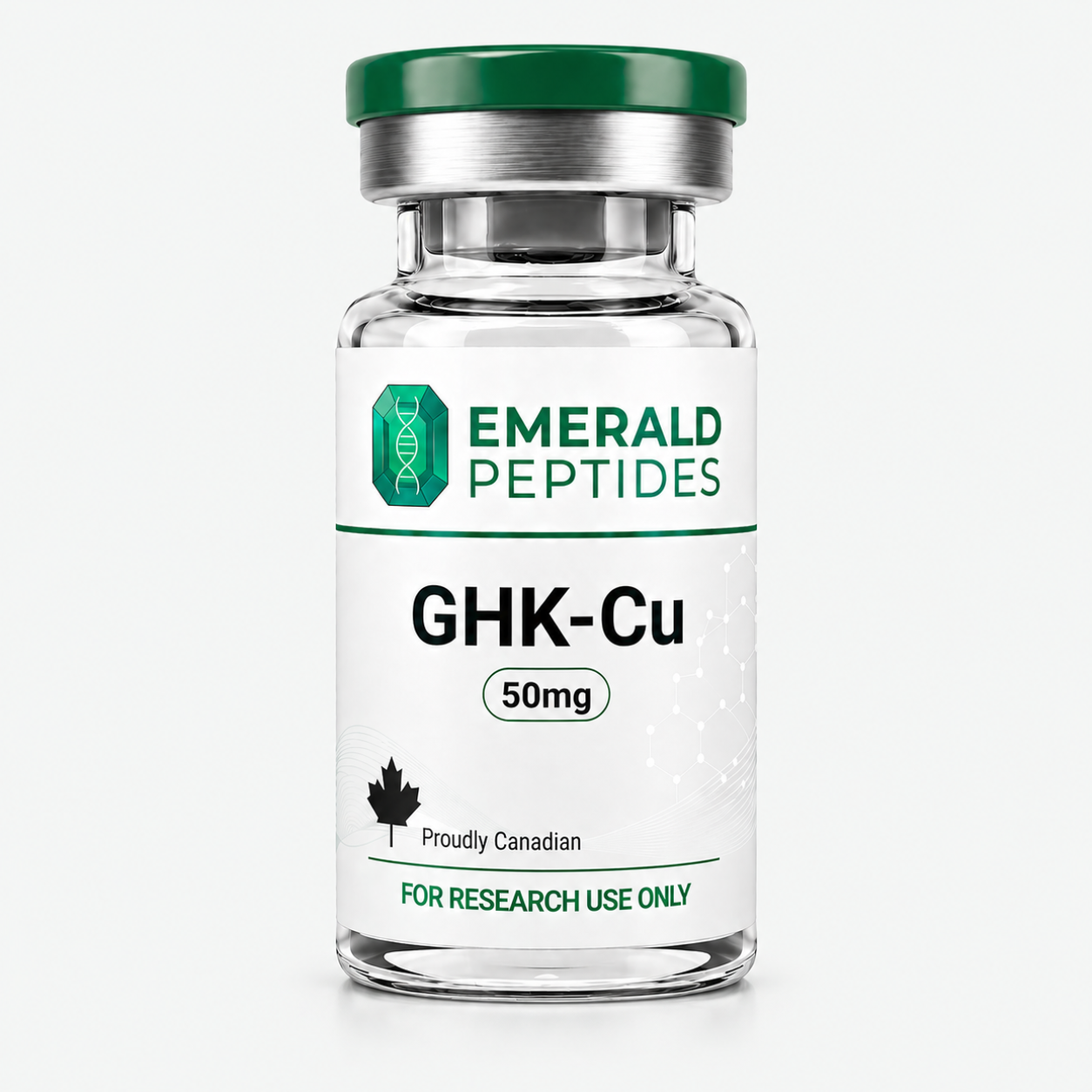
GHK-Cu
GHK-Cu
In stock
592 units sold
- Lab Tested for Purity & Quality
- Fast & Secure Shipping
 Manufactured in Canada


GHK-Cu — Copper Tripeptide for Skin and ECM
Buy GHK-Cu in Canada as a research-grade copper tripeptide complex for ECM remodeling, skin biology, hair follicle, and gene expression research designs. GHK-Cu is a naturally occurring copper complex of the tripeptide glycyl-L-histidyl-L-lysine, originally isolated by Loren Pickart from human plasma in 1973. The compound is one of the most extensively characterized small peptides in published research, with documented effects on collagen synthesis, glycosaminoglycan production, and approximately 4,000 human gene expression changes. Each vial supplied by Emerald Peptides ships at ≥99% HPLC purity with mass-spec-verified identity, batch-specific certificate of analysis, and fast domestic Canadian shipping.
Product Details
- Form: Lyophilized peptide complex
- Net per vial: 50 mg (filled to approximately 104% of label)
- Purity: ≥99% (HPLC-verified)
- Identity: MS-verified (per COA)
- Storage: 2–8 °C, protect from light
- Formula / M.W.: C₁₄H₂₃CuN₆O₄ / ~401.91 Da
- CAS: 49557-75-7
What Makes GHK-Cu a Unique Compound
GHK-Cu was isolated in 1973 by Dr. Loren Pickart from human plasma, after he observed that serum from older donors aged liver tissue cultures more rapidly than serum from younger donors. The factor responsible turned out to be a small copper-binding tripeptide whose endogenous concentration declines with age — from roughly 200 ng/mL at age 20 to 80 ng/mL at age 60. The 50-year research arc that followed makes GHK-Cu one of the most thoroughly characterized small peptides in the literature.
What distinguishes GHK-Cu among research peptides is its breadth of biological activity relative to its size. Genomic profiling published by Pickart and colleagues identified expression changes across roughly 4,000 human genes, spanning extracellular matrix biology, antioxidant defense, DNA repair, and tumor suppressor pathways. The compound is endogenously released at sites of tissue injury through breakdown of SPARC and type I collagen — meaning its biology connects directly to repair signaling rather than acting as an exogenous-only tool compound.
Key Benefits
- Skin & ECM Remodeling — Published cell and animal studies have measured GHK-Cu-driven increases in collagen, decorin, and glycosaminoglycan synthesis in dermal fibroblasts, supporting its use as a reference tool in skin biology and ECM research.
- Wound Repair & Angiogenesis — Rodent wound models have reported accelerated re-epithelialization and increased capillary density in GHK-Cu-treated cohorts, with mechanistic work pointing to fibroblast recruitment, immune cell signaling, and pro-angiogenic gene expression.
- Hair Follicle Research — Animal and ex vivo follicle studies have documented enlargement of hair follicles and extended anagen-phase signaling in GHK-Cu-exposed tissue, generating sustained interest in the peptide for hair biology research.
- Broad Gene Expression Modulation — Genomic studies have characterized GHK-Cu's effect on the expression of thousands of human genes, including upregulation of DNA repair and tumor suppressor pathways and downregulation of inflammatory mediators — making it a unique tool for transcriptomic research.
- Antioxidant & Anti-Inflammatory Signaling — GHK-Cu modulates copper-dependent enzymatic activity and reduces lipid peroxidation in cell models, with published work linking effects to redox-balance and cytokine-pathway research.
Related Peptides
Researchers working with GHK-Cu often investigate it alongside:
- BPC-157 — Pentadecapeptide studied for cytoprotection and tissue repair via nitric oxide and VEGFR2-driven angiogenesis; the most common research pairing with GHK-Cu in soft-tissue and dermal repair designs.
- TB-500 — Synthetic thymosin β-4 studied for cellular migration and angiogenesis; complements GHK-Cu's ECM-remodeling profile with a cytoskeletal-mechanism research angle.
- Glow Stack — Combined BPC-157 + TB-500 + GHK-Cu research blend for groups studying skin biology and connective tissue repair across multiple parallel mechanisms.
Frequently Asked Questions
What should purchasers consider before they buy peptides like GHK-Cu?
Three things matter most: verified purity, identity confirmation, and supply-chain integrity. Our GHK-Cu ships with a batch-specific certificate of analysis confirming ≥99% HPLC purity and mass-spec-verified identity, vials are filled to approximately 104% of label as a quality margin, and orders dispatch from within Canada to avoid border-related cold-chain interruptions. For copper-peptide complexes specifically, batch-level documentation of stoichiometry and copper content is worth confirming before purchase.
What is the difference between GHK and GHK-Cu?
GHK is the bare tripeptide (glycyl-L-histidyl-L-lysine), while GHK-Cu is the same tripeptide bound to a copper(II) ion. The tripeptide has high affinity for copper, and most of GHK's documented biological activity in the published literature is mediated by the copper complex — particularly its effects on antioxidant enzyme activity, ECM remodeling, and gene expression. GHK without copper has different and generally weaker activity in most research models.
Is GHK-Cu naturally occurring?
Yes. GHK-Cu is endogenously present in human plasma, saliva, and urine, with the tripeptide sequence sitting within larger ECM proteins like SPARC and type I collagen. It is released into circulation when those parent proteins break down at sites of tissue injury. The synthetic peptide sold for research is sequence-identical to the endogenous form.
What is the evidence base for GHK-Cu?
The published literature spans more than 50 years and includes biochemical, cell-based, animal, and human studies across wound healing, skin biology, hair follicle research, gene expression profiling, and oncology models. Loren Pickart and colleagues published over 100 papers on GHK biology, including the genomic work that characterized its effect on roughly 4,000 human genes.
⚠️ For research use only. Not intended for human or veterinary use. Not a drug, food, or supplement.