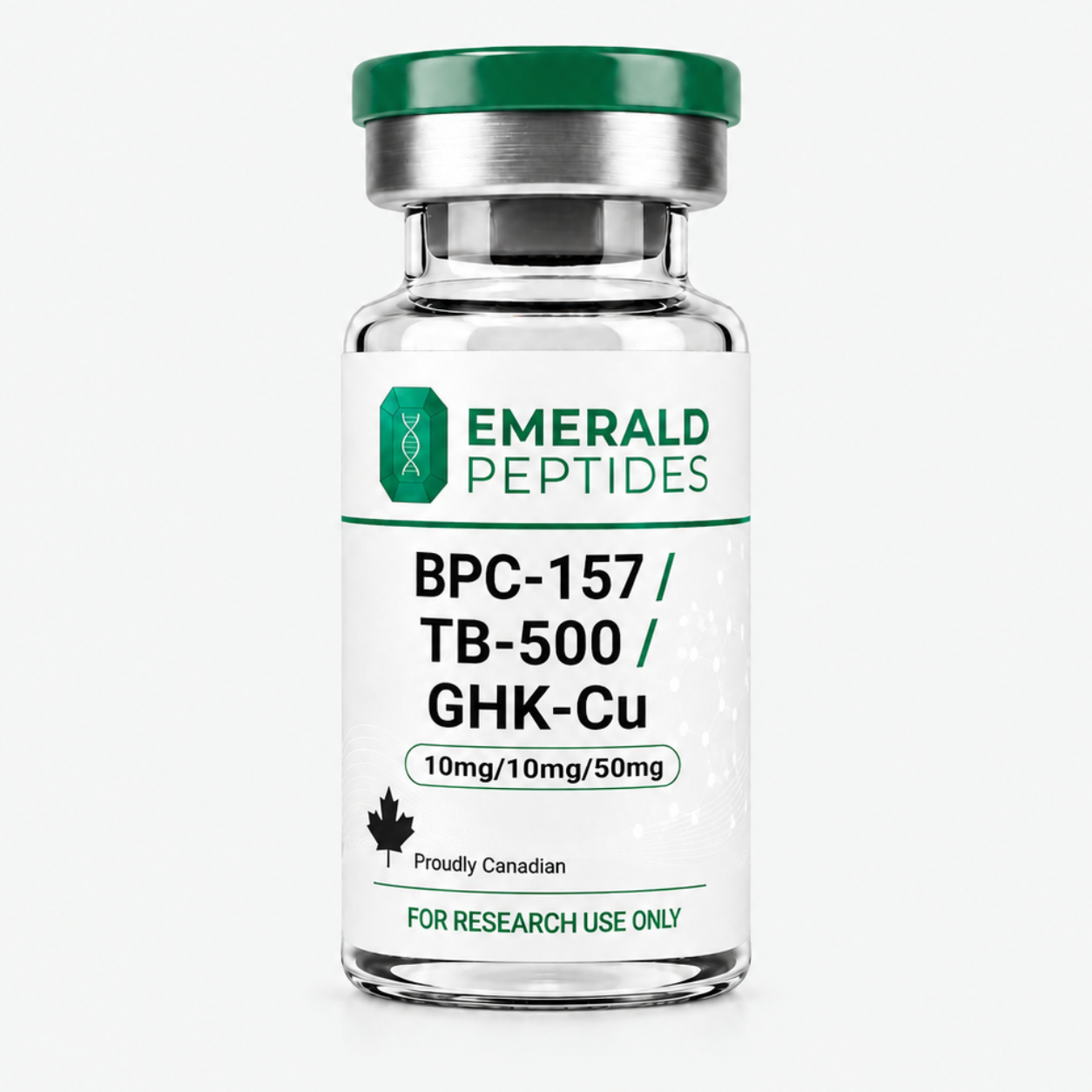
Glow Stack (BPC-157 + TB-500 + GHK-Cu)
Glow Stack (BPC-157 + TB-500 + GHK-Cu)
In stock
358 units sold
- Lab Tested for Purity & Quality
- Fast & Secure Shipping
 Manufactured in Canada


BPC-157 + TB-500 + GHK-Cu Stack — The Glow Stack for Multi-Pathway Research
The Glow Stack combines BPC-157, TB-500, and GHK-Cu into a single matched-batch research kit for multi-pathway dermal repair, ECM remodeling, and tissue-level research designs. Each compound in the BPC-157 TB-500 GHK-Cu stack engages a distinct mechanism — BPC-157 through nitric oxide pathway and VEGFR2-mediated angiogenesis, TB-500 through G-actin sequestration and cellular migration regulation, and GHK-Cu through copper-mediated ECM remodeling and gene expression modulation. The mechanism non-overlap gives research designs three complementary tools in matched documentation. Each component ships at ≥99% HPLC purity with mass-spec-verified identity, batch-specific certificates of analysis, and fast domestic Canadian shipping.
Product Details
- Form: Three lyophilized compounds, supplied as a kit
- Net per kit: 10 mg BPC-157 + 10 mg TB-500 + 50 mg GHK-Cu (each filled to approximately 104% of label)
- Purity: ≥99% (HPLC-verified, all components)
- Identity: MS-verified per COA (all components)
- Storage: 2–8 °C, protect from light
- Components: See individual product pages for full sequence, formula, MW, and CAS data
What Makes the Glow Stack a Unique Combination
The Glow Stack builds on the BPC-157 + TB-500 repair backbone — already the most frequent two-peptide pairing in published soft-tissue research — and adds GHK-Cu to extend the design into ECM remodeling, gene-expression modulation, and skin biology. The rationale is mechanistic stratification: each compound operates through a distinct molecular pathway, so research designs incorporating the full stack can probe parallel mechanisms in the same model system without confounding overlap.
The combination also reflects the breadth of supporting literature. BPC-157 has over 100 published animal studies across repair domains. The thymosin β-4 literature spans four decades. GHK-Cu's published research arc reaches back to its 1973 isolation from human plasma by Loren Pickart, with subsequent genomic profiling identifying expression changes across roughly 4,000 human genes. The Glow Stack gives Canadian research groups a single supply point for all three reference compounds, with batch-specific certificates of analysis confirming ≥99% HPLC purity for each constituent.
Key Benefits
- Multi-Pathway Skin & ECM Research — The stack allows research designs to address nitric-oxide-pathway, actin-cytoskeleton, and copper-mediated ECM-remodeling mechanisms simultaneously, giving each compound a defined role in the same model system.
- Collagen & Glycosaminoglycan Synthesis — GHK-Cu has documented effects on dermal fibroblast collagen, decorin, and glycosaminoglycan production. Combined with BPC-157 and TB-500's separate repair-pathway activity, the stack covers structural ECM endpoints alongside vascular and cytoskeletal mechanisms.
- Hair Follicle Research — GHK-Cu has measured effects on hair follicle morphology and anagen-phase signaling in animal and ex vivo models. Stacked with BPC-157 and TB-500's vascular and cytoskeletal contributions, the combination supports hair-biology research with multiple parallel mechanisms.
- Wound Repair & Re-Epithelialization — All three compounds have published activity in rodent wound models — BPC-157 via cytoprotection and angiogenesis, TB-500 via keratinocyte and fibroblast migration, GHK-Cu via fibroblast recruitment and pro-angiogenic gene expression. Combined research designs build on three independent literatures.
- Gene Expression & Transcriptomic Research — GHK-Cu's documented activity across thousands of human genes makes the Glow Stack uniquely suited to research designs combining functional repair endpoints with transcriptomic analysis.
Related Peptides
Researchers working with the Glow Stack often investigate it alongside:
- BPC-157 — Available as a single-compound vial for research designs requiring BPC-157 alone or at non-stack ratios.
- TB-500 — Available as a single-compound vial for research designs requiring TB-500 alone or at non-stack ratios.
- GHK-Cu — Available as a single-compound vial for research designs requiring GHK-Cu alone or at non-stack ratios.
- Wolverine Stack — The two-compound BPC-157 + TB-500 backbone, for research designs that don't extend into ECM-remodeling and skin-biology endpoints.
Frequently Asked Questions
What makes this kit a glow peptide Canada researchers source for skin and ECM work?
Three reasons. First, the published preclinical literature for the constituent compounds — BPC-157, TB-500, and GHK-Cu — covers skin biology, ECM remodeling, hair follicle research, and wound repair across decades of work. Second, the mechanistic stratification across nitric-oxide, cytoskeletal, and copper-mediated ECM pathways gives research designs clean tool separation. Third, sourcing all three compounds as a matched-batch kit shipped from within Canada simplifies documentation and avoids cold-chain interruptions at the border.
How is the Glow Stack different from the Wolverine Stack?
The Wolverine Stack is the two-compound BPC-157 + TB-500 repair backbone, focused on soft-tissue and angiogenesis research. The Glow Stack adds GHK-Cu to that backbone, extending the design into ECM remodeling, broad gene-expression modulation, and skin-biology research. Research groups studying tendon, ligament, or muscle repair without dermal endpoints typically work with the Wolverine Stack; groups whose designs include skin, hair, or ECM-remodeling research add GHK-Cu and use the Glow Stack.
Why are these three compounds frequently studied together in skin research?
Each operates through a distinct mechanism with documented activity in dermal and connective-tissue models. BPC-157 contributes cytoprotection and VEGFR2-mediated angiogenesis. TB-500 contributes cellular migration and capillary network formation through G-actin sequestration. GHK-Cu contributes ECM-remodeling, collagen and glycosaminoglycan synthesis, and broad gene-expression modulation through copper-mediated signaling. Combined research designs cover three parallel mechanisms in a single model.
Are the three compounds naturally occurring?
In varying degrees. BPC-157's 15-amino-acid sequence corresponds to a region of body protective compound found in human gastric juice; the synthetic peptide is the isolated fragment. TB-500 is the synthetic full-length sequence of thymosin β-4, endogenous to most mammalian cell types. GHK-Cu is fully endogenous, present in human plasma, saliva, and urine, and released at sites of tissue injury through breakdown of SPARC and type I collagen. The synthetic preparations are sequence-identical to their endogenous forms.
⚠️ For research use only. Not intended for human or veterinary use. Not a drug, food, or supplement.