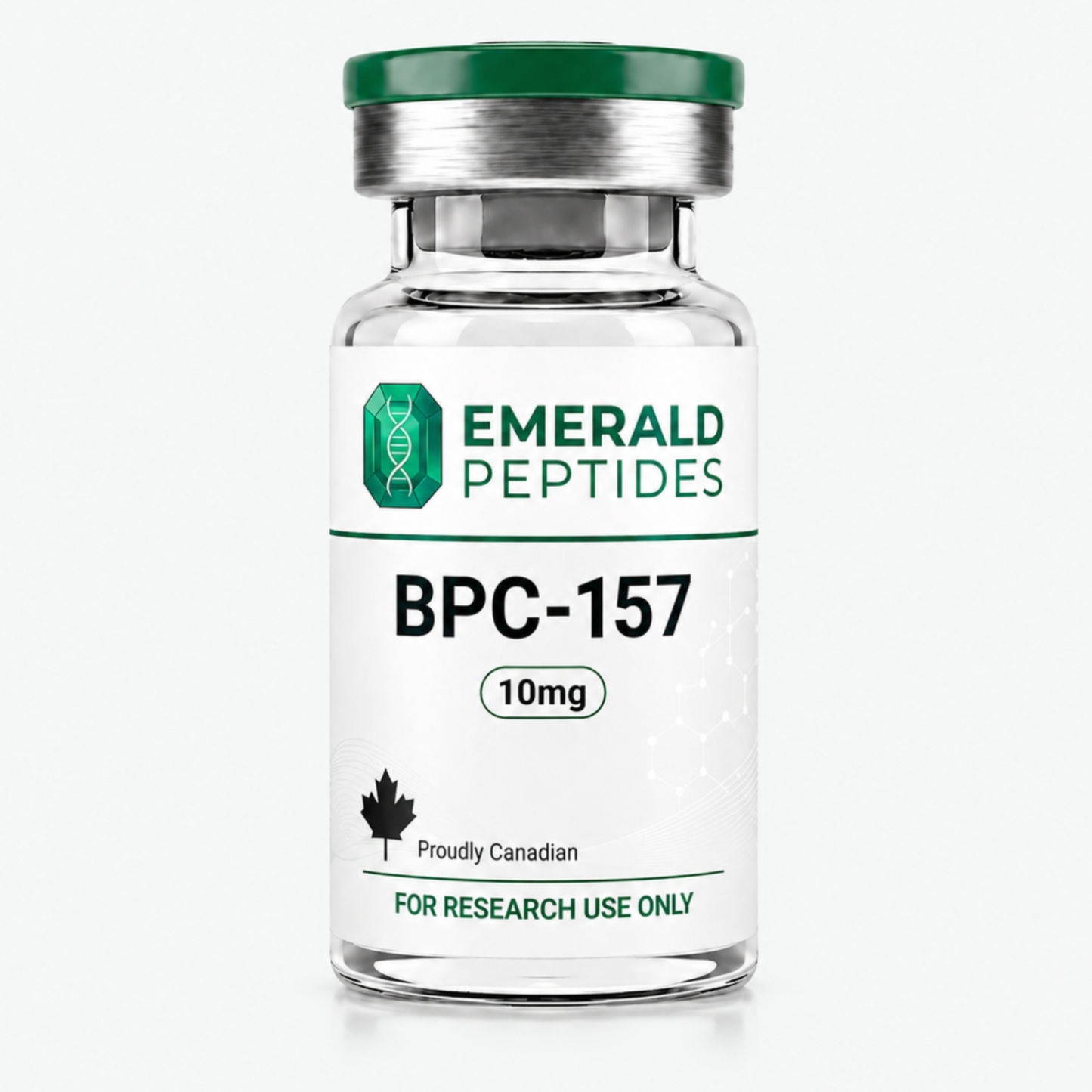
BPC-157
BPC-157
In stock
1293 units sold
- Lab Tested for Purity & Quality
- Fast & Secure Shipping
 Manufactured in Canada


Buy BPC-157 — Gastric-Derived Pentadecapeptide
Buy BPC-157 from Emerald Peptides as a research-grade pentadecapeptide for tissue repair, cytoprotection, and gastrointestinal research designs. BPC-157 is a synthetic 15-amino-acid peptide derived from a partial sequence of body protective compound (BPC), originally isolated from human gastric juice. With more than 100 published animal studies covering gastrointestinal injury, musculoskeletal repair, vascular research, and neural protection models, BPC-157 has one of the broadest preclinical evidence bases in the recovery research peptide category. Each vial ships at ≥99% HPLC purity with mass-spec-verified identity, batch-specific certificate of analysis, and fast domestic Canadian shipping.
Product Details
- Form: Lyophilized peptide
- Net per vial: [CONFIRM — common SKU sizes: 5 mg / 10 mg]
- Purity: ≥99% (HPLC-verified)
- Identity: MS-verified (per COA)
- Storage: 2–8 °C, protect from light
- Formula / M.W.: C₆₂H₉₈N₁₆O₂₂ / 1419.55 Da
- CAS: 137525-51-0
What Makes BPC-157 a Unique Compound
BPC-157 was characterized by Croatian researchers in the early 1990s as a stable fragment of body protective compound, a larger protein found in gastric juice. What set it apart immediately was its stability in acidic gastric environments and its activity without a carrier protein — properties that made it accessible for a wide range of preclinical models.
The peptide's broad-tissue activity is unusual. Published animal studies report effects on smooth muscle, tendon, ligament, bone, gut mucosa, and vascular endothelium, with mechanistic work pointing to nitric-oxide pathway modulation and pro-angiogenic VEGFR2 signaling. This combination makes BPC-157 a frequent reference compound in repair and cytoprotection research, including studies modeling NSAID-induced gastric injury where conventional models have struggled to find responsive tools.
Key Benefits
- Gastrointestinal Cytoprotection — Animal studies report protective effects against NSAID-induced and stress-induced gastric lesions, with researchers attributing the activity to nitric oxide pathway modulation and mucosal repair signaling.
- Tendon & Ligament Repair — Published rodent models, including transected Achilles tendon and medial collateral ligament studies, have reported accelerated reorganization of collagen and fibroblast migration in BPC-157-treated groups versus controls.
- Angiogenesis & Vascular Remodeling — Preclinical work has documented upregulation of VEGFR2 expression and improved capillary density in injury models, supporting investigation into BPC-157's role in tissue vascularization research.
- Neuroprotection — Animal models of traumatic brain injury, peripheral nerve transection, and ischemic insult have reported reduced lesion progression and improved functional recovery in BPC-157 cohorts, generating ongoing interest in CNS repair research.
- Anti-Inflammatory Modulation — Studies have measured reductions in pro-inflammatory cytokine expression and improved outcomes in colitis and arthritis models, framing BPC-157 as a candidate for investigation into systemic inflammatory responses.
Related Peptides
Researchers working with BPC-157 often investigate it alongside:
- TB-500 — Thymosin β4 fragment studied for cellular migration and angiogenesis; the most common pairing in published soft-tissue repair research and the basis of our Wolverine Stack (see below).
- GHK-Cu — Copper tripeptide investigated for ECM remodeling and wound repair; complements BPC-157's cytoprotective profile with a copper-mediated gene-expression angle, and pairs with both compounds in our Glow Stack.
- Wolverine Stack — Combined BPC-157 + TB-500 research blend for groups studying repair pathways in parallel.
- Retatrutide (GLP-3) — BPC-157's activity in NAFLD and MASH models pairs with hepatic-lipid research using Retatrutide.
Frequently Asked Questions
How is BPC-157 different from TB-500?
Both are studied in tissue repair contexts but engage different pathways. BPC-157 is a 15-amino-acid pentadecapeptide derived from gastric BPC, with mechanistic work focused on nitric oxide signaling and VEGFR2-mediated angiogenesis. TB-500 is a synthetic fragment of thymosin β4 and is studied primarily for actin-binding-driven cell migration. Many research designs use them together to model complementary repair pathways.
Is BPC-157 naturally occurring?
Partially. The 15-amino-acid sequence corresponds to a region of body protective compound, a protein identified in human gastric juice. The synthetic peptide sold for research is the isolated pentadecapeptide fragment — it does not occur as a free peptide in nature, but its sequence is drawn from a naturally occurring parent protein.
What is the evidence base for BPC-157?
The published preclinical literature spans more than three decades and over 100 animal studies across gastrointestinal, musculoskeletal, vascular, and neural models. A 2022 pharmacokinetic study in Frontiers in Pharmacology characterized distribution and metabolism in rats and dogs. Human clinical data remain limited, with most evidence drawn from rodent and other animal models.
⚠️ For research use only. Not intended for human or veterinary use. Not a drug, food, or supplement.