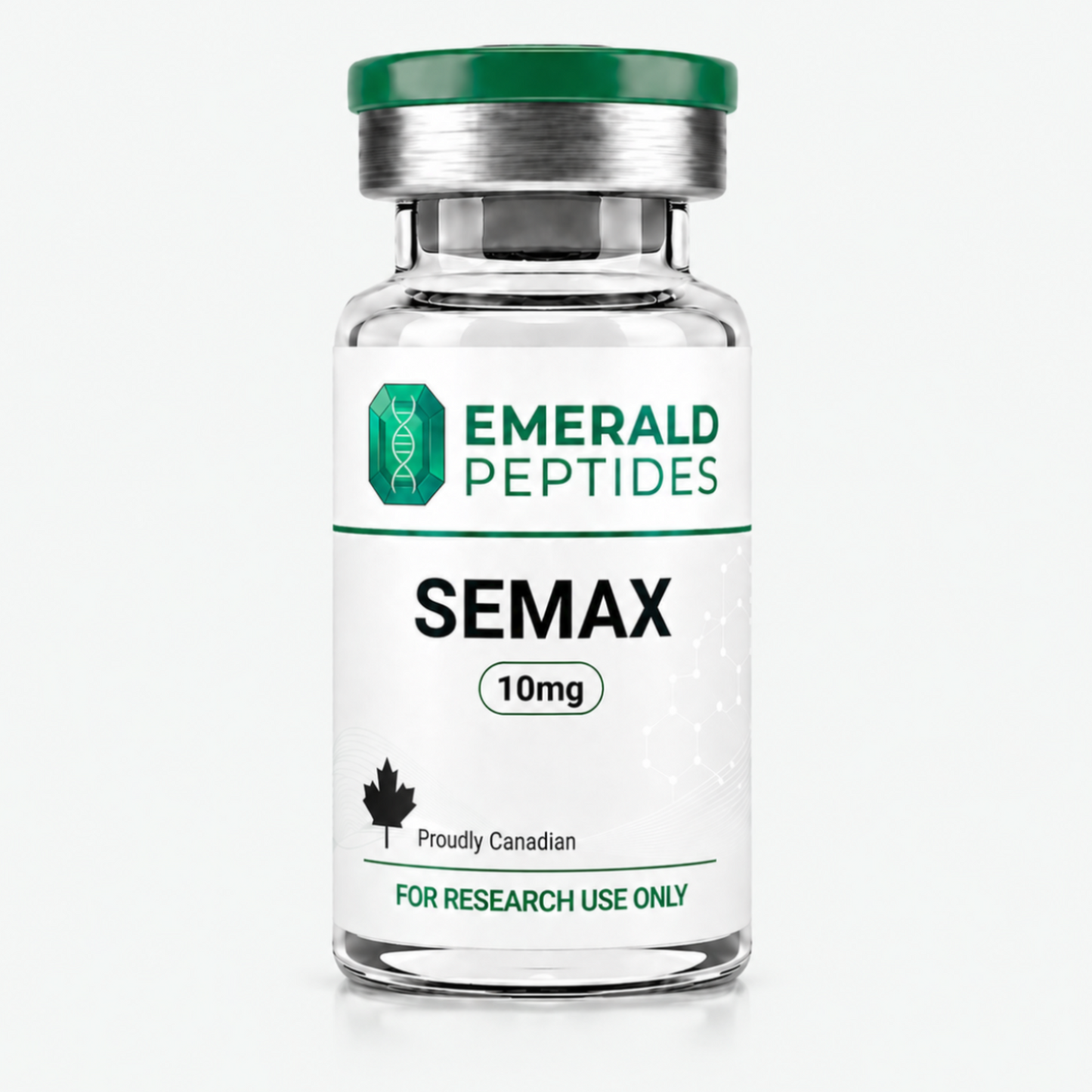
Semax
Semax
In stock
302 units sold
- Lab Tested for Purity & Quality
- Fast & Secure Shipping
 Manufactured in Canada


Semax — Synthetic ACTH(4-10) Analog
Buy Semax in Canada as a research-grade synthetic peptide for nootropic, neuroprotective, and BDNF-modulation research designs. Semax is a synthetic heptapeptide analog of ACTH(4-10), originally developed at the Institute of Molecular Genetics of the Russian Academy of Sciences and approved for clinical use in Russia and Ukraine for ischemic stroke and post-stroke neurorehabilitation. Each vial supplied by Emerald Peptides ships at ≥99% HPLC purity with mass-spec-verified identity, batch-specific certificate of analysis, and fast domestic Canadian shipping.
Product Details
- Form: Lyophilized peptide
- Net per vial: 10 mg (filled to approximately 104% of label)
- Purity: ≥99% (HPLC-verified)
- Identity: MS-verified (per COA)
- Storage: 2–8 °C, protect from light
- Formula / M.W.: C₃₇H₅₁N₉O₁₀S / 813.92 Da
- CAS: 80714-61-0
What Makes Semax a Unique Compound
Semax was developed at the Institute of Molecular Genetics of the Russian Academy of Sciences — the same institute that produced its sister compound Selank — and is approved for human clinical use in Russia for ischemic stroke, optic nerve disorders, and post-stroke neurorehabilitation. That clinical track gives Semax a published human dataset that few regulatory peptides circulating in Western research markets can match.
Structurally, Semax retains the ACTH(4-7) tetrapeptide core but deliberately omits the Arg-Trp-Gly residues that would otherwise confer melanocortin receptor activity. The result is a compound with the neurotrophic and cognitive-modulatory effects of ACTH-derived peptides, decoupled from the pigmentary and steroidogenic activity of native ACTH or melanocortin agonists — making Semax a clean tool for groups studying neurotrophin pathways without confounding melanocortin receptor engagement.
Key Benefits
- Nootropic & Cognitive Research — Rodent studies have measured rapid elevation of hippocampal BDNF and TrkB expression following Semax exposure, alongside improved performance in learning, memory, and attention paradigms — supporting its use as a reference tool in neurotrophin-mediated cognitive research.
- Neuroprotection in Ischemia — Published rat models of permanent middle cerebral artery occlusion and global ischemia have reported reduced infarct progression, attenuated cortical nitric oxide overproduction, and modulated immune-response gene expression in Semax-treated cohorts.
- Neurotrophin Pathway Modulation — Beyond BDNF, Semax has been examined for effects on NGF expression and TrkA signaling, framing it as a broad-spectrum neurotrophin-pathway research tool.
- Anxiolytic & Stress Response — Animal models have measured increased open-arm time in elevated plus-maze paradigms and attenuated stress-induced behavioral disruption in Semax-treated rodents.
- Copper-Binding & Aβ Aggregation — Recent biochemical studies have characterized Semax's ability to form stable complexes with copper(II) ions in an albumin-like coordination mode, with downstream effects on copper-induced amyloid-β aggregation in neuronal cell models.
Related Peptides
Researchers working with Semax often investigate it alongside:
- Selank — The sister regulatory heptapeptide developed at the same Russian institute; Selank targets GABAergic and immunomodulatory pathways for anxiolytic research, complementing Semax's BDNF-driven cognitive and neuroprotective profile in CNS research designs.
- BPC-157 — Pentadecapeptide with documented neuroprotective activity in rodent models of TBI and peripheral nerve injury; pairs with Semax in research designs spanning CNS repair, nerve regeneration, and cytoprotection endpoints.
- Tesamorelin — GHRH analog with published cognitive-aging research data, including effects on brain GABA and myo-inositol ratios; provides a complementary mechanism for groups studying peptide-mediated cognitive function across endocrine and regulatory-peptide axes.
Frequently Asked Questions
Why source Semax from a Canadian peptides supplier?
Sourcing within Canada means shorter cold-chain transit and no cross-border customs interruptions, both of which matter for lyophilized peptides shipped to research labs. Our Semax is supplied with batch-specific certificates of analysis confirming ≥99% HPLC purity and mass-spec identity verification, and vials are filled to approximately 104% of the labeled 10 mg as a quality margin for residual losses during reconstitution.
How is Semax different from Selank?
Both are synthetic heptapeptide regulatory peptides developed at the Institute of Molecular Genetics of the Russian Academy of Sciences, but they target different research domains. Semax is an ACTH(4-10) analog studied primarily for nootropic, neuroprotective, and BDNF-modulating effects in cognitive and ischemic-injury research. Selank is a tuftsin analog studied primarily for anxiolytic and immunomodulatory effects via GABAergic and enkephalin-stabilization pathways. Many research designs use them in parallel to address cognitive and neuro-immune endpoints simultaneously.
Is Semax naturally occurring?
No. Semax is fully synthetic. Its core sequence corresponds to amino acids 4–7 of the endogenous adrenocorticotropic hormone (ACTH), but the full Met-Glu-His-Phe-Pro-Gly-Pro heptapeptide does not occur in nature — the C-terminal Pro-Gly-Pro extension is engineered to confer metabolic stability beyond what native ACTH fragments achieve.
How does Semax differ from native ACTH or melanocortin agonists?
Native ACTH(4-10) contains the Arg-Trp-Gly motif required for melanocortin receptor activation. Semax deliberately omits these residues, retaining only the ACTH(4-7) core plus the Pro-Gly-Pro extension. This produces a compound with neurotrophic and cognitive activity independent of melanocortin receptor engagement, distinguishing it cleanly from peptides like Melanotan 2 or PT-141.
⚠️ For research use only. Not intended for human or veterinary use. Not a drug, food, or supplement.