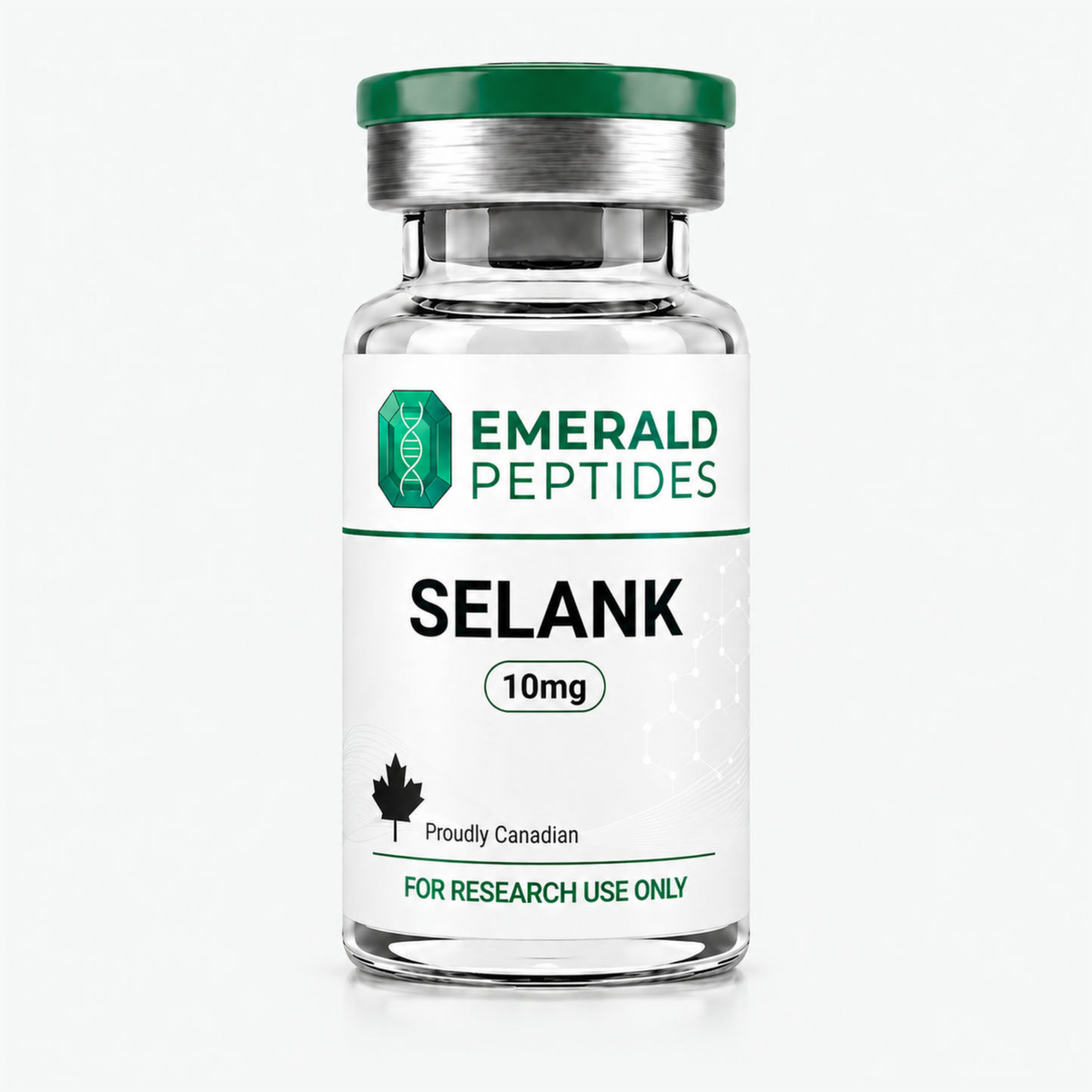
Selank
Selank
Out of stock
189 units sold
- Lab Tested for Purity & Quality
- Fast & Secure Shipping
 Manufactured in Canada


Selank — Synthetic Tuftsin Analog
Buy Selank in Canada as a research-grade synthetic peptide for anxiolytic, immunomodulatory, and GABAergic research designs. Selank is a synthetic heptapeptide analog of the endogenous immunomodulator tuftsin, developed at the Institute of Molecular Genetics of the Russian Academy of Sciences and approved for clinical use in Russia and Ukraine for generalized anxiety disorder. Each vial supplied by Emerald Peptides ships at ≥99% HPLC purity with mass-spec-verified identity, batch-specific certificate of analysis, and fast domestic Canadian shipping.
Product Details
- Form: Lyophilized peptide
- Net per vial: 10 mg (filled to approximately 104% of label)
- Purity: ≥99% (HPLC-verified)
- Identity: MS-verified (per COA)
- Storage: 2–8 °C, protect from light
- Formula / M.W.: C₃₃H₅₇N₁₁O₉ / 751.88 Da
- CAS: 129954-34-3
What Makes Selank a Unique Compound
Selank was developed at the Institute of Molecular Genetics of the Russian Academy of Sciences in collaboration with the V.V. Zakusov Research Institute of Pharmacology, and is approved for human clinical use as an anxiolytic in Russia and Ukraine — a regulatory profile that distinguishes it from most synthetic regulatory peptides circulating in Western research markets. Its parent compound, tuftsin, is a four-amino-acid fragment of the IgG heavy chain Fc region with documented immunomodulatory activity.
The structural innovation in Selank is the C-terminal Pro-Gly-Pro tripeptide. This extension shields tuftsin from enzymatic cleavage and produces a peptide that retains the parent's immunoregulatory profile while adding well-characterized anxiolytic and cognitive activity. Among research peptides operating at the neuro-immune interface, Selank is one of the few tools with both a developed clinical dataset and a clear mechanistic profile spanning GABAergic, monoaminergic, and enkephalin-pathway endpoints.
Key Benefits
- Anxiolytic / GABAergic Modulation — Rodent studies have measured increased amplitude and discharge rate of inhibitory postsynaptic currents in hippocampal CA1 neurons following Selank exposure, supporting investigation into GABAergic-mediated anxiety models without the dependence profile associated with benzodiazepine tools.
- Nootropic & Cognitive Research — Published animal models have reported improvements in learning, memory consolidation, and orientational-investigative behavior, with mechanistic work linking effects to BDNF expression and serotonin metabolism modulation.
- Immune & Cytokine Modulation — Selank has been characterized in animal studies as a modulator of IL-6 expression and T-helper cell cytokine balance, retaining the immunoregulatory profile of its tuftsin parent compound.
- Enkephalin Stabilization & Opioid Withdrawal Research — Preclinical work has examined Selank's inhibition of enkephalin degradation in models of morphine withdrawal, with rat studies measuring attenuation of aversive withdrawal signs following administration.
- Stress Response — Animal studies of acute stress have reported reduced affective response and decreased erroneous escape attempts in Selank-treated cohorts, framing the peptide as a research tool for HPA-axis and behavioral stress paradigms.
Related Peptides
Researchers working with Selank often investigate it alongside:
- Semax — The sister regulatory heptapeptide developed at the same Russian institute; Semax targets BDNF/NGF pathways for cognitive and neuroprotective research, complementing Selank's anxiolytic and immunomodulatory profile in CNS research designs.
- BPC-157 — Pentadecapeptide with documented anxiolytic and gut-brain-axis activity in rodent models; pairs with Selank in research designs probing the intersection of GI biology, stress response, and behavioral endpoints.
- Tesamorelin — GHRH analog with published cognitive-aging research data; provides a complementary mechanism for groups studying peptide-mediated cognitive function across endocrine and regulatory-peptide axes.
Frequently Asked Questions
Why source Selank from a Canadian peptides CA supplier?
Sourcing within Canada means shorter cold-chain transit and no cross-border customs interruptions, both of which matter for lyophilized peptides shipped to research labs. Our Selank is supplied with batch-specific certificates of analysis confirming ≥99% HPLC purity and mass-spec identity verification, and vials are filled to approximately 104% of the labeled 10 mg as a quality margin for residual losses during reconstitution.
How is Selank different from Semax?
Both are synthetic heptapeptide regulatory peptides developed at the Institute of Molecular Genetics of the Russian Academy of Sciences, but they target different research domains. Selank is a tuftsin analog studied primarily for anxiolytic and immunomodulatory effects, with documented activity in GABAergic and enkephalin-stabilization research. Semax is an ACTH(4–10) analog studied primarily for BDNF/NGF-mediated cognitive and neuroprotective research. Many research designs use them in parallel to address neuro-immune and cognitive endpoints simultaneously.
Is Selank naturally occurring?
The parent peptide, tuftsin (Thr-Lys-Pro-Arg), is a naturally occurring tetrapeptide produced from immunoglobulin G heavy chain cleavage. Selank itself, with its C-terminal Pro-Gly-Pro extension, is fully synthetic — the seven-amino-acid sequence does not occur in nature, and the extension was deliberately engineered to extend the metabolic stability of the native tuftsin fragment.
What is the evidence base for Selank?
Selank has been studied extensively in Russian and international preclinical literature since the 1990s, with characterized effects across anxiety, cognition, immune modulation, and opioid-withdrawal models. It is approved for human anxiolytic use in Russia and Ukraine, providing a clinical dataset most regulatory peptides lack. Mechanistic work has implicated GABAergic, serotonergic, BDNF-pathway, and enkephalinase-inhibition contributions.
⚠️ For research use only. Not intended for human or veterinary use. Not a drug, food, or supplement.