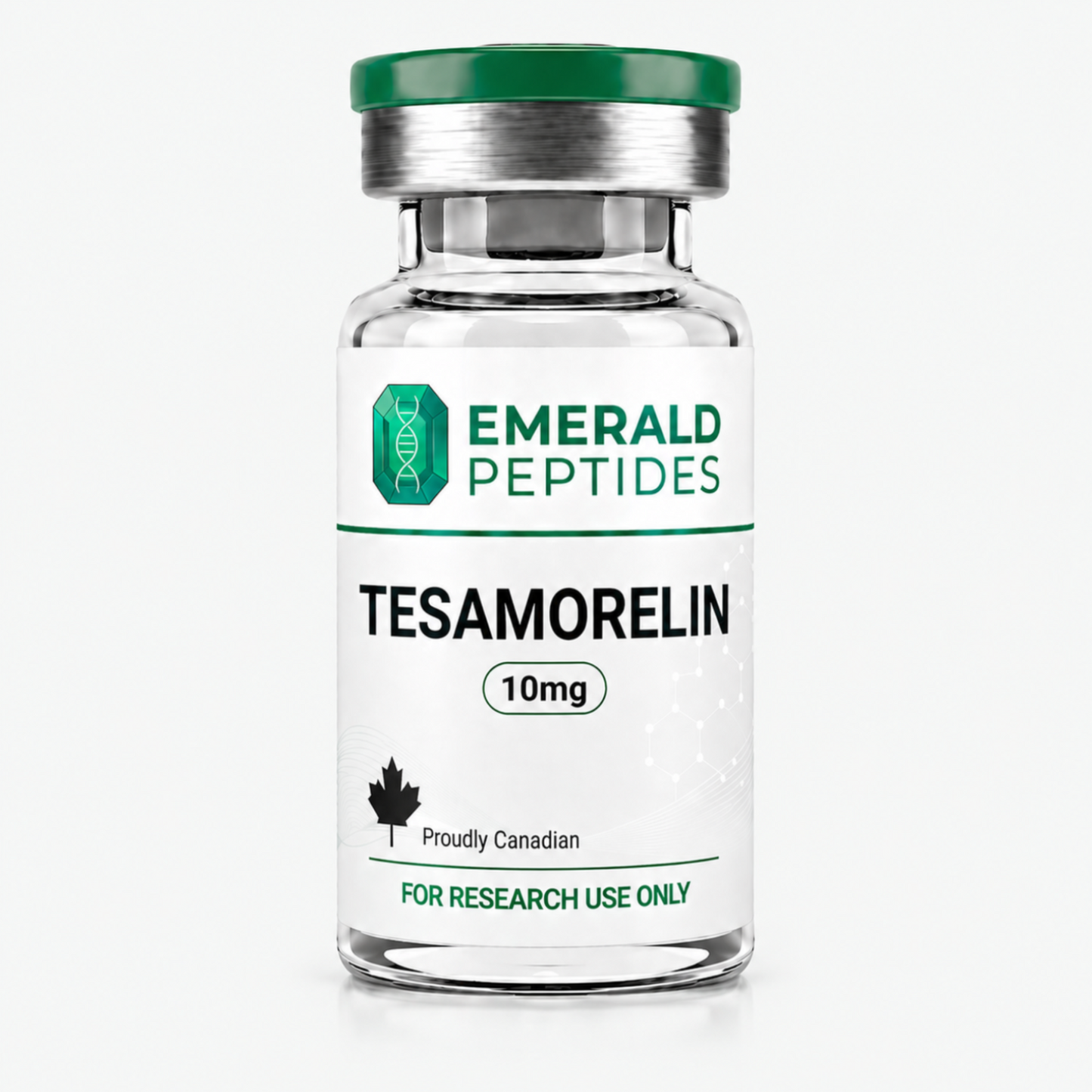
Tesamorelin
Tesamorelin
In stock
621 units sold
- Lab Tested for Purity & Quality
- Fast & Secure Shipping
 Manufactured in Canada


Buy Tesamorelin Canada — Synthetic GHRH(1-44) Analog
Buy Tesamorelin in Canada as a research-grade GHRH analog for somatotropic axis, lean mass, and visceral adiposity research designs. Tesamorelin is a synthetic 44-amino-acid analog of growth-hormone-releasing hormone (GHRH), engineered with an N-terminal trans-3-hexenoic acid modification that confers resistance to DPP-IV cleavage. Developed by Montreal-based Theratechnologies and approved by the FDA in 2010 under the brand name Egrifta for visceral adiposity in HIV-associated lipodystrophy, Tesamorelin remains the only GHRH analog to receive regulatory approval. Each vial supplied by Emerald Peptides ships at ≥99% HPLC purity with mass-spec-verified identity, batch-specific certificate of analysis, and fast domestic Canadian shipping.
Product Details
- Form: Lyophilized peptide
- Net per vial: 10 mg (filled to approximately 104% of label)
- Purity: ≥99% (HPLC-verified)
- Identity: MS-verified (per COA)
- Storage: 2–8 °C, protect from light
- Formula / M.W.: C₂₂₁H₃₆₆N₇₂O₆₇S / ~5135.9 Da
- CAS: 218949-48-5
What Makes Tesamorelin a Unique Compound
Tesamorelin was developed by Theratechnologies, Inc., a Montreal-based biotech, and remains the only GHRH analog to receive FDA approval — granted in 2010 for visceral adiposity reduction in HIV-associated lipodystrophy under the brand name Egrifta. That clinical track gives researchers a published human pharmacokinetic, pharmacodynamic, and safety dataset most research peptides cannot match.
Structurally, Tesamorelin retains the full 44-amino-acid hGHRH sequence, distinguishing it from shorter GHRH fragments like sermorelin (GHRH 1-29). The trans-3-hexenoic acid moiety attached to the N-terminal tyrosine extends half-life by blocking DPP-IV cleavage at the Tyr¹-Ala² bond, the primary degradation site for native GHRH. Among Canadian research compounds with a documented clinical trail, Tesamorelin sits in a small group of GHRH-axis tools available for laboratory investigation.
Key Benefits
- GH/IGF-1 Axis Activation — Tesamorelin elicits pulsatile GH secretion through GHRHR agonism, with downstream IGF-1 elevation observed across published preclinical and clinical pharmacodynamic studies — making it a reference tool for somatotropic-axis investigation.
- Lean Mass & Anabolic Research — GH and IGF-1 elevation drive protein synthesis and skeletal muscle anabolism in published animal models, supporting Tesamorelin's use in research designs comparing GH-axis activation against alternative anabolic peptide mechanisms.
- Visceral Adiposity — Phase 3 clinical trials demonstrated dose-dependent reductions in visceral adipose tissue, mediated through GH-stimulated hormone-sensitive lipase activity. The dataset gives researchers a uniquely well-characterized human reference for GH-driven lipolysis.
- Lipid Metabolism & Cardiometabolic Markers — Published trials have measured improvements in triglyceride profiles and adiponectin alongside VAT reduction, generating sustained interest in Tesamorelin as a tool for cardiometabolic-pathway research.
- Cognitive Aging Research — Randomized studies have explored Tesamorelin's effects on cognitive markers and brain GABA/myo-inositol ratios in older adults, opening a parallel research direction beyond its primary metabolic indication.
Related Peptides
Researchers working with Tesamorelin often investigate it alongside:
- Retatrutide — Triple GLP-1/GIP/glucagon agonist; provides a clean mechanistic contrast to GH-axis-driven body composition effects in metabolic-research designs.
- MOTS-c — Mitochondria-derived peptide investigated for insulin sensitivity and exercise-mimetic activity; complements Tesamorelin's endocrine angle with cellular-energetics research.
- BPC-157 — Pentadecapeptide studied for tissue repair and cytoprotection; pairs with Tesamorelin in research designs combining anabolic signaling and recovery endpoints.
Frequently Asked Questions
Where can researchers buy Tesamorelin in Canada with verified purity?
Our Tesamorelin ships to Canadian research labs and independent investigators with a batch-specific certificate of analysis confirming ≥99% HPLC purity and mass-spec identity verification. Vials are filled to approximately 104% of the labeled 10 mg as a quality margin for residual losses during reconstitution work, and ship from within Canada to avoid border-related cold-chain interruptions. Tesamorelin was originally developed in Canada by Theratechnologies, giving it a notable connection to Canadian peptide research.
How is Tesamorelin different from sermorelin or CJC-1295?
Sermorelin is a truncated GHRH(1-29) fragment with a much shorter half-life. CJC-1295 is also based on GHRH(1-29) but adds amino acid substitutions (and, in DAC variants, a maleimidopropionic acid linker for albumin binding). Tesamorelin retains the full GHRH(1-44) sequence with N-terminal lipid modification, giving it both DPP-IV resistance and the full receptor-binding domain of native GHRH — a different structural strategy from the truncated analogs.
Is Tesamorelin naturally occurring?
Partially. The 44-amino-acid sequence corresponds to native human GHRH, an endogenous hypothalamic peptide. The N-terminal trans-3-hexenoic acid modification is synthetic and does not occur in nature; it is added specifically to extend metabolic stability for research and clinical use.
What is the evidence base for Tesamorelin?
Tesamorelin has the most developed evidence base of any GHRH analog. Phase 3 clinical trials in HIV-associated lipodystrophy supported its 2010 FDA approval, with published data on visceral fat reduction, IGF-1 elevation, lipid profiles, and tolerability. Subsequent research has examined cognitive aging, NAFLD, and broader metabolic endpoints.
⚠️ For research use only. Not intended for human or veterinary use. Not a drug, food, or supplement.