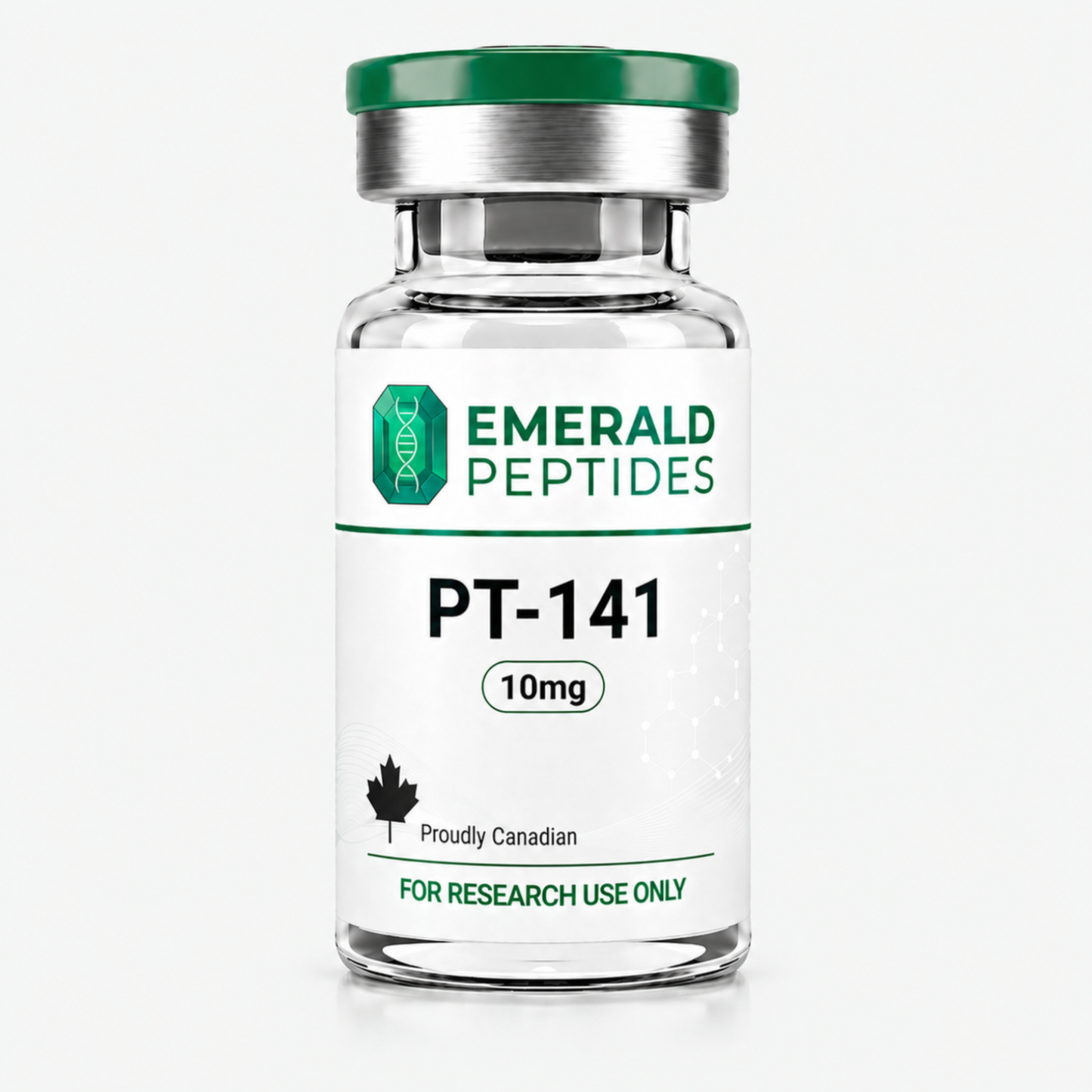
PT-141
PT-141
Out of stock
187 units sold
- Lab Tested for Purity & Quality
- Fast & Secure Shipping
 Manufactured in Canada


PT-141 — Melanocortin Receptor Agonist
Buy PT-141 in Canada as a research-grade melanocortin receptor agonist for CNS sexual response, neuropharmacology, and MC3R/MC4R research designs. PT-141 (also known by the international nonproprietary name bremelanotide) is a synthetic cyclic heptapeptide originally derived from Melanotan II, developed by Palatin Technologies and approved by the FDA in 2019 under the brand name Vyleesi for hypoactive sexual desire disorder. Each vial supplied by Emerald Peptides ships at ≥99% HPLC purity with mass-spec-verified identity, batch-specific certificate of analysis, and fast domestic Canadian shipping.
Product Details
- Form: Lyophilized peptide
- Net per vial: 10 mg (filled to approximately 104% of label)
- Purity: ≥99% (HPLC-verified)
- Identity: MS-verified (per COA)
- Storage: 2–8 °C, protect from light
- Formula / M.W.: C₅₀H₆₈N₁₄O₁₀ / 1025.2 Da
- CAS: 189691-06-3
What Makes PT-141 a Unique Compound
PT-141 traces its origin to the University of Arizona melanocortin research program led by Victor Hruby and Mac Hadley, where structure-activity work on Melanotan 2 produced the now well-known observation that broad-spectrum melanocortin agonism engaged not only pigmentation pathways but also CNS-mediated sexual response circuitry. Palatin Technologies subsequently developed PT-141 (bremelanotide) as a more receptor-selective compound that preserved the CNS activity while attenuating peripheral melanocortin engagement.
What distinguishes PT-141 in current research is its regulatory status. In June 2019, the FDA approved bremelanotide under the brand name Vyleesi for hypoactive sexual desire disorder in premenopausal women, making it the only peptide-based melanocortin agonist with full FDA clinical validation in this domain. That approval gives researchers a published Phase 3 dataset, characterized human pharmacokinetics, and a defined mechanism — properties most research peptides lack. Its action is mediated centrally via hypothalamic melanocortin receptors, distinguishing it mechanistically from peripheral vasodilator approaches to sexual dysfunction research.
Key Benefits
- CNS-Mediated Sexual Response — Animal and clinical studies have characterized PT-141's activation of hypothalamic MC3R and MC4R as the basis for downstream effects on sexual desire and arousal circuitry, distinguishing it from peripheral vasodilator compounds in mechanistic research.
- Melanocortin Receptor Pharmacology — PT-141 serves as a reference MC3R/MC4R-preferring agonist in receptor-deconvolution studies, frequently compared against non-selective tools like Melanotan 2 to dissect receptor-subtype contributions.
- Appetite & Energy Balance — Hypothalamic MC4R activation has been studied in animal models for its role in feeding suppression, and PT-141 contributes to the published dataset on MC4R-mediated satiety signaling.
- Pharmacokinetic Characterization — As one of few melanocortin peptides with detailed published clinical pharmacokinetic data, PT-141 functions as a reference compound for groups studying cyclic-heptapeptide ADME profiles.
- Comparator in Sexual Function Research — PT-141's centrally mediated mechanism makes it a frequently used comparator in research designs evaluating peptide-based versus small-molecule approaches to sexual response pathway investigation.
Related Peptides
Researchers working with PT-141 often investigate it alongside:
- Melanotan II (MT-2) — The non-selective parent compound from which PT-141 is derived; the standard mechanistic contrast for receptor-selectivity studies and one of the most common research pairings in the published melanocortin literature.
- Tesamorelin — GHRH analog acting on hypothalamic-pituitary signaling; provides a complementary mechanism for groups studying peptide-mediated CNS-endocrine pathway activity alongside melanocortin research.
- GHK-Cu — Copper tripeptide investigated for skin and ECM remodeling; pairs with PT-141 in research designs spanning the skin-and-sexual-health endpoints common in melanocortin-system studies.
Frequently Asked Questions
Why is PT-141 frequently described as a best peptide for male potential increase research?
PT-141 is the most clinically validated research peptide acting on CNS-mediated sexual response pathways. It engages MC3R and MC4R in hypothalamic circuits associated with sexual desire and arousal, mechanistically distinct from peripheral vasodilator compounds like PDE5 inhibitors. The compound completed Phase 3 clinical trials under the brand name Vyleesi and received FDA approval in 2019 for hypoactive sexual desire disorder. That published dataset, combined with a defined receptor-selectivity profile, places it among the most studied research peptides in male and female sexual response models.
How is PT-141 different from Melanotan 2?
Both are cyclic heptapeptide α-MSH analogs with the same seven-amino-acid sequence. The single structural difference is at the C-terminus: PT-141 ends in a carboxylic acid (-OH), while Melanotan 2 ends in an amide (-NH₂). PT-141 is the active metabolite of Melanotan 2 in vivo. Functionally, the substitution shifts receptor selectivity toward MC3R and MC4R while reducing MC1R engagement, meaning PT-141 retains the CNS-mediated sexual response profile while showing diminished pigmentation activity compared to its parent.
Is PT-141 naturally occurring?
No. PT-141 is fully synthetic, engineered as a stable cyclic analog of α-MSH, the natural 13-amino-acid melanocortin hormone. The structural modifications — D-phenylalanine substitution, norleucine for methionine, and the Asp-Lys lactam bridge — are non-natural and confer the metabolic stability that endogenous α-MSH lacks.
What is the evidence base for PT-141?
PT-141 has one of the most developed evidence bases of any research-relevant melanocortin peptide. Phase 3 clinical trials in premenopausal women with hypoactive sexual desire disorder supported its 2019 FDA approval under the brand name Vyleesi. The preclinical literature spans more than two decades and includes published work in male and female sexual response, melanocortin receptor pharmacology, and pharmacokinetic characterization. Earlier-stage clinical work in male erectile dysfunction was also conducted, providing additional published data points.
⚠️ For research use only. Not intended for human or veterinary use. Not a drug, food, or supplement.