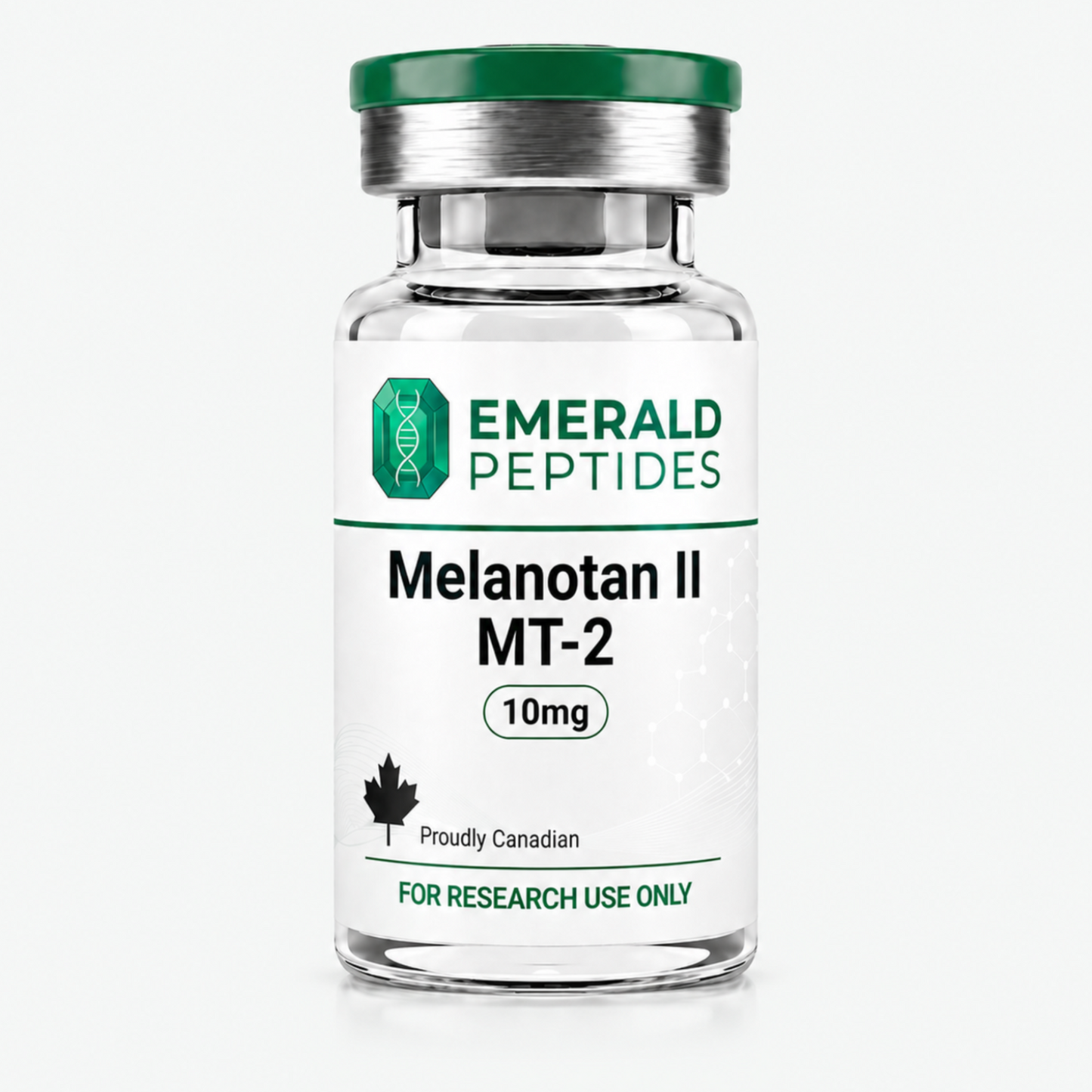
Melanotan II (MT-2)
Melanotan II (MT-2)
In stock
791 units sold
- Lab Tested for Purity & Quality
- Fast & Secure Shipping
 Manufactured in Canada


Buy Melanotan 2 Canada — Synthetic α-MSH Analog
Buy Melanotan 2 in Canada as a research-grade synthetic melanocortin agonist for pigmentation, appetite, and sexual response research designs. Melanotan 2 (MT-2) is a synthetic cyclic heptapeptide analog of α-melanocyte-stimulating hormone (α-MSH), originally developed at the University of Arizona in the 1980s. The compound acts as a non-selective agonist across multiple melanocortin receptors (MC1R through MC5R), giving research designs broad pharmacological access to melanocortin biology. Each vial supplied by Emerald Peptides ships at ≥99% HPLC purity with mass-spec-verified identity, batch-specific certificate of analysis, and fast domestic Canadian shipping.
Product Details
- Form: Lyophilized peptide
- Net per vial: 10 mg (filled to approximately 104% of label)
- Purity: ≥99% (HPLC-verified)
- Identity: MS-verified (per COA)
- Storage: 2–8 °C, protect from light
- Formula / M.W.: C₅₀H₆₉N₁₅O₉ / 1024.18 Da
- CAS: 121062-08-6
What Makes Melanotan 2 a Unique Compound
Melanotan 2 was developed at the University of Arizona by Victor Hruby and colleagues in the late 1980s as part of a structure-activity program designed to produce metabolically stable α-MSH analogs. The key innovations — replacement of methionine with norleucine, substitution of L-phenylalanine with its D-enantiomer, and lactamization between aspartic acid and lysine to lock the peptide into its bioactive conformation — produced a compound with substantially extended half-life and full agonist activity at multiple melanocortin receptors.
What distinguishes Melanotan 2 from later melanocortin tools is its broad receptor profile. Where bremelanotide (PT-141) shows preferential activity at MC4R, Melanotan 2 acts as a non-selective agonist across MC1R, MC3R, MC4R, and MC5R — making it a useful reference compound for groups dissecting receptor-specific contributions to melanocortin pathway phenotypes.
Key Benefits
- Pigmentation & Melanogenesis — MC1R activation in melanocyte models drives eumelanin synthesis through cAMP-PKA-MITF signaling. Published cell and animal studies have measured dose-dependent increases in melanin content following Melanotan 2 exposure, supporting its use as a reference tool in pigmentation research.
- Appetite & Energy Balance — Hypothalamic MC3R and MC4R activation has been studied for its role in feeding suppression. Rodent models have reported reduced food intake across multiple hyperphagia paradigms following intracerebroventricular Melanotan 2 administration.
- Melanocortin Receptor Pharmacology — As a non-selective full agonist, Melanotan 2 serves as a baseline tool compound in receptor-deconvolution studies where researchers compare its profile against subtype-selective agonists and antagonists.
- UV Photoprotection Research — Eumelanin produced via MC1R activation absorbs UV radiation, and Melanotan 2 has been investigated in animal models as a tool for studying tan-mediated photoprotection independent of UV exposure.
- Sexual Response Circuitry — MC3R/MC4R activation in CNS pathways has been examined in animal models of sexual response, with Melanotan 2 preceding the development of more receptor-selective compounds in this research area.
Related Peptides
Researchers working with Melanotan 2 often investigate it alongside:
- PT-141 — Bremelanotide, an MC3R/MC4R-preferring melanocortin agonist; the standard mechanistic contrast for Melanotan 2 in receptor-selectivity studies.
- GHK-Cu — Copper tripeptide investigated for ECM remodeling and skin biology; complements Melanotan 2's pigmentation focus with a separate copper-mediated dermal-research angle.
- BPC-157 — Pentadecapeptide studied for cytoprotection and tissue repair; pairs with Melanotan 2 in dermal-research designs spanning pigmentation and repair endpoints.
Frequently Asked Questions
Where can researchers buy Melanotan 2 in Canada with verified purity?
Our Melanotan 2 ships to Canadian research labs and independent investigators with a batch-specific certificate of analysis confirming ≥99% HPLC purity and mass-spec identity verification. Vials are filled to approximately 104% of the labeled 10 mg as a quality margin for residual losses during reconstitution work, and ship from within Canada to avoid border-related cold-chain interruptions.
How is Melanotan 2 different from PT-141?
Both are α-MSH-derived melanocortin agonists, but they differ in receptor selectivity. Melanotan 2 is a non-selective full agonist across MC1R, MC3R, MC4R, and MC5R, making it active in pigmentation, appetite, and sexual-response research. PT-141 (bremelanotide) shows preferential activity at MC3R and MC4R, with reduced MC1R engagement, which is why it became the focus of CNS-mediated sexual response research while Melanotan 2 remained a broader pigmentation and melanocortin-pathway tool.
Is Melanotan 2 naturally occurring?
No. Melanotan 2 is a synthetic cyclic heptapeptide engineered as a stable analog of α-MSH, the natural melanocortin hormone that consists of a 13-amino-acid linear sequence. The structural modifications — D-phenylalanine substitution, norleucine for methionine, and the Asp-Lys lactam bridge — are deliberately non-natural and confer the metabolic stability that endogenous α-MSH lacks.
What is the evidence base for Melanotan 2?
The published preclinical literature spans more than three decades, beginning with foundational structure-activity work from Hruby and colleagues at the University of Arizona in the late 1980s and 1990s. Subsequent cell and animal studies have characterized melanogenesis, appetite, and CNS effects across multiple model systems. Pilot human clinical data exist but Melanotan 2 has not received approval from any major regulatory agency for human use.
⚠️ For research use only. Not intended for human or veterinary use. Not a drug, food, or supplement.