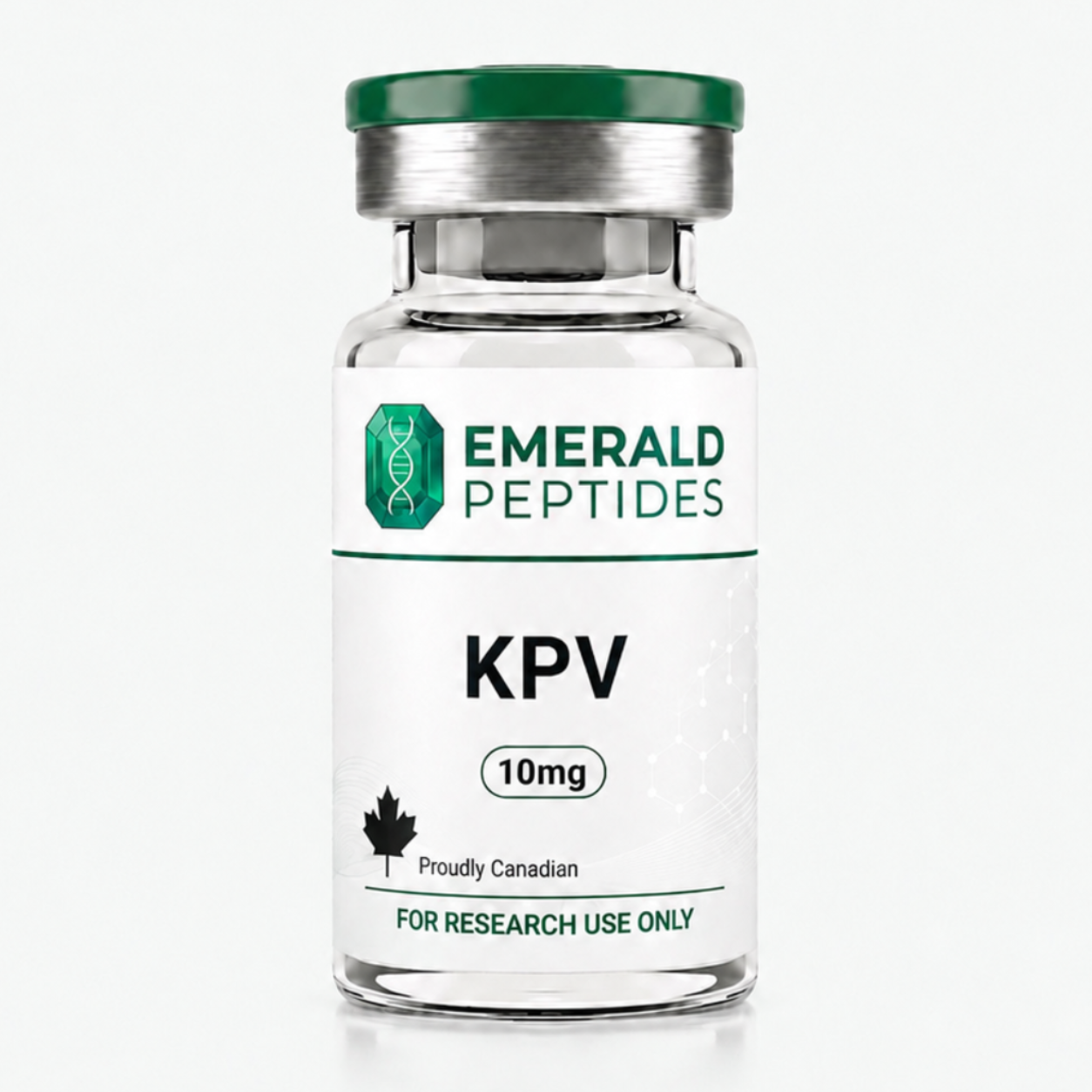
KPV
KPV
In stock
- Lab Tested for Purity & Quality
- Fast & Secure Shipping
 Manufactured in Canada


Buy KPV in Canada — Anti-Inflammatory Tripeptide Research Peptide
Buy KPV in Canada as a research-grade anti-inflammatory tripeptide for inflammatory disease models, tissue repair, and immunomodulation research designs. KPV (Lys-Pro-Val) is the C-terminal tripeptide of α-melanocyte-stimulating hormone (α-MSH) — the specific fragment responsible for α-MSH's anti-inflammatory activity without the pigmentary (melanotropic) effects of the full parent molecule. First characterized by Hiltz and Lipton in 1989 and subsequently developed through decades of preclinical research, KPV has become a standard reference tripeptide across IBD/colitis models, wound healing research, and NF-κB pathway investigation. Each vial supplied by Emerald Peptides ships at ≥99% HPLC purity with mass-spec-verified identity, batch-specific certificate of analysis, and fast domestic Canadian shipping.
Product Details
- Form: Lyophilized peptide
- Net per vial: 10 mg (filled to approximately 104% of label)
- Purity: ≥99% (HPLC-verified)
- Identity: MS-verified (per COA)
- Storage: 2–8 °C, protect from light
- Formula / M.W.: C16H30N4O4 / 342.4 Da
- CAS: 30948-93-1
What Makes KPV a Unique Compound
KPV is a three-amino-acid peptide — one of the shortest bioactive peptides in current research use — that retains the full anti-inflammatory activity of its 13-amino-acid parent molecule, α-MSH, while eliminating the pigmentary side effects that limit α-MSH's own research utility. The tripeptide corresponds to positions 11–13 of α-MSH (also written as α-MSH(11–13)), representing the C-terminal fragment that carries the peptide's anti-inflammatory and antipyretic activity.
The compound's mechanism operates primarily through NF-κB pathway inhibition, with published research documenting suppression of TNF-α, IL-6, and nitric oxide production alongside induction of IL-10 expression. KPV is transported across intestinal epithelium by the PepT1 peptide transporter, giving it particular research relevance in gastrointestinal inflammation models. Its foundational anti-inflammatory characterization by J.M. Lipton and colleagues in the late 1980s and early 1990s established KPV as a reference tripeptide across melanocortin research, and subsequent work by Kannengiesser, Maaser, and colleagues extended its documented activity into inflammatory bowel disease models.
Key Benefits
- Inflammatory Bowel Disease Models — KPV has been extensively characterized in DSS colitis and CD45RB(hi) transfer colitis murine models, where published data reports reductions in inflammatory markers, mucosal damage, and disease activity indices — making it a reference tripeptide in IBD research designs.
- NF-κB Pathway Investigation — Published cellular research documents KPV-mediated inhibition of NF-κB activation in response to TNF-α stimulation, giving researchers a defined molecular handle for studying transcription factor-mediated inflammatory signaling.
- Cytokine Modulation — Preclinical models have measured KPV effects on TNF-α, IL-6, IL-1β, and nitric oxide production, supporting research designs investigating cytokine-mediated inflammatory cascades and immunomodulatory responses.
- Skin and Wound Inflammation — Research has examined KPV's activity in dermatological inflammation and wound healing contexts, where the tripeptide's anti-inflammatory action without melanotropic side effects distinguishes it from full α-MSH for skin research applications.
- Neuroinflammation Research — A 2013 study by Holloway and colleagues reported that single-dose administration of α-MSH(11–13) attenuated brain damage in a controlled cortical impact traumatic brain injury model in mice, extending KPV's research applications into neuroprotection and CNS inflammation research.
Related Peptides
Researchers working with KPV often investigate it alongside:
- BPC-157 — Pentadecapeptide studied in gastrointestinal repair, tissue healing, and cytoprotection research with mechanism complementarity to KPV in gut inflammation models.
- TB-500 — Thymosin β-4-derived peptide studied in cellular migration, wound healing, and dermal repair research alongside anti-inflammatory compounds.
- GHK-Cu — Copper tripeptide investigated in skin repair, ECM remodeling, and gene expression research with overlapping applications in dermatological inflammation models.
Frequently Asked Questions
What is KPV derived from?
KPV is the C-terminal tripeptide (positions 11–13) of α-melanocyte-stimulating hormone (α-MSH), a 13-amino-acid neuropeptide derived from proopiomelanocortin (POMC). Published research established that the anti-inflammatory activity of α-MSH resides substantially in this C-terminal tripeptide, allowing KPV to retain the parent molecule's anti-inflammatory effects while avoiding the pigmentation-inducing (melanotropic) effects associated with the full peptide.
What is the evidence base for KPV in inflammation research?
KPV has been characterized across multiple preclinical inflammation models since the late 1980s, with foundational work by J.M. Lipton and colleagues and subsequent expansion into IBD models by Kannengiesser, Maaser, and colleagues. Published research documents anti-inflammatory activity in DSS colitis, CD45RB(hi) transfer colitis, dermatological inflammation models, and cellular NF-κB assays. Peer-reviewed research is searchable through PubMed under KPV and α-MSH(11–13).
How is KPV different from full α-MSH?
Both compounds share anti-inflammatory activity, but full α-MSH is a 13-amino-acid peptide that also produces melanotropic (pigmentation) effects through its N-terminal region. KPV corresponds to only the C-terminal three amino acids (positions 11–13) — the portion responsible for anti-inflammatory activity — and does not produce pigmentation effects. This makes KPV particularly useful in research designs where anti-inflammatory investigation must be separated from melanotropic confounders.
⚠️ For research use only. Not intended for human or veterinary use. Not a drug, food, or supplement.