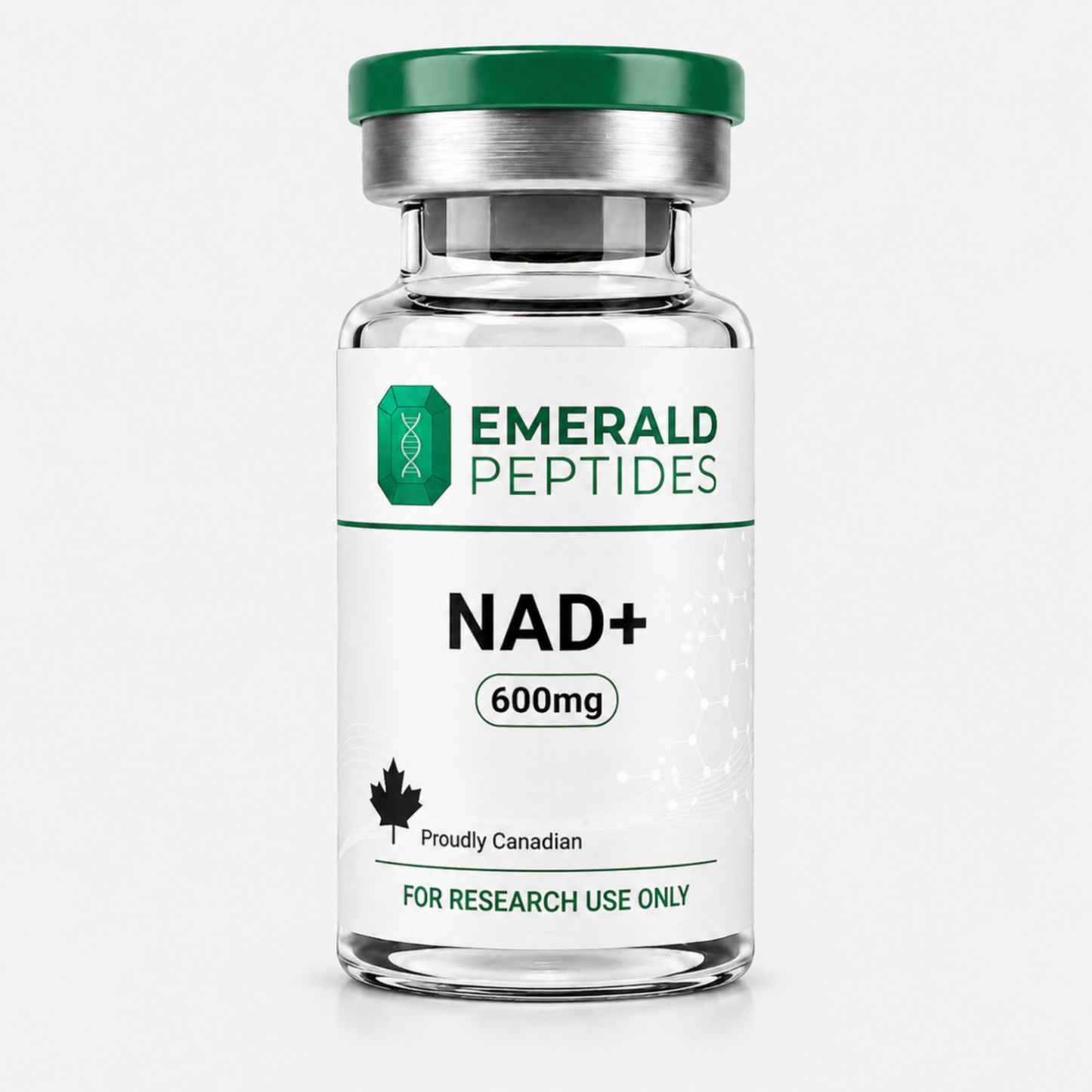
NAD+
NAD+
In stock
422 units sold
- Lab Tested for Purity & Quality
- Fast & Secure Shipping
 Manufactured in Canada


NAD+ – β-Nicotinamide Adenine Dinucleotide
Buy NAD+ in Canada as a research-grade β-nicotinamide adenine dinucleotide for cellular bioenergetics, sirtuin biology, DNA damage response, and mitochondrial research designs. NAD+ is a pyridine dinucleotide coenzyme that operates as both an electron acceptor in cellular respiration and a substrate for sirtuin deacetylases, PARP enzymes, and CD38. Tissue NAD+ levels decline progressively with age, making the compound central to aging research and the broader field of cellular bioenergetics. Each vial supplied by Emerald Peptides ships at ≥99% HPLC purity with mass-spec-verified identity, batch-specific certificate of analysis, and fast domestic Canadian shipping.
Product Details
- Form: Lyophilized free acid
- Net per vial: 600 mg (filled to approximately 104% of label)
- Purity: ≥99% (HPLC-verified)
- Identity: MS-verified (per COA)
- Storage: 2–8 °C, protect from light; long-term storage at −20 °C
- Formula / M.W.: C₂₁H₂₇N₇O₁₄P₂ / 663.43 Da
- CAS: 53-84-9
What Makes NAD+ a Unique Compound
NAD+ was first identified in 1906 by Arthur Harden and William Young as a low-molecular-weight cofactor in boiled yeast extracts, and was subsequently linked to pellagra prevention through niacin metabolism by Conrad Elvehjem in 1937. The molecule's structural simplicity — two nucleotides linked through their phosphate groups — masks an extraordinary biological reach: NAD+ participates in hundreds of enzymatic reactions across all known living cells.
What distinguishes NAD+ in current research is its dual identity as both a redox cofactor and a consumed substrate. The redox cycling between NAD+ and NADH supports oxidative phosphorylation and ATP synthesis. Separately, NAD+ is consumed by sirtuin deacetylases, PARP enzymes during DNA damage response, and CD38 during cyclic ADP-ribose signaling. This consumption-versus-recycling distinction is central to the modern NAD+ literature — researchers studying age-related NAD+ decline focus on the balance between salvage-pathway synthesis and consuming-enzyme demand. Research groups examining mitochondrial dysfunction, metabolic syndrome, and aging frequently use NAD+ as a tool compound to probe sirtuin-pathway biology and bioenergetic regulation.
Key Benefits
- Mitochondrial Bioenergetics — NAD+ serves as the primary electron acceptor in glycolysis, the TCA cycle, and fatty acid oxidation, making it a foundational tool compound in studies of cellular energy metabolism and mitochondrial function across in vitro and in vivo models.
- Sirtuin Pathway Activation — Sirtuins (SIRT1–SIRT7) consume NAD+ to deacetylate histone and non-histone protein substrates, and NAD+ availability is the rate-limiting input for sirtuin activity. Published research has used NAD+ to probe sirtuin-mediated regulation of metabolic, longevity, and stress-response pathways.
- DNA Damage Response & PARP Activity — Poly(ADP-ribose) polymerases consume large quantities of NAD+ during DNA damage response signaling. Research groups studying genotoxic stress, chemotherapy response, and aging-associated DNA damage frequently incorporate NAD+ as a substrate in cell-based and animal designs.
- Aging & Longevity — Published human and animal data document age-associated declines in tissue NAD+ levels, with replenishment strategies in rodent models linked to improvements in mitochondrial function, insulin sensitivity, and physical performance markers in aged cohorts.
- Metabolic & Cardiometabolic Models — NAD+ supplementation in rodent models of obesity, insulin resistance, and NAFLD has been examined for effects on glucose homeostasis, hepatic lipid handling, and inflammatory markers, generating sustained interest in NAD+ as a research tool for cardiometabolic-pathway investigation.
Related Peptides
Researchers working with NAD+ often investigate it alongside:
- MOTS-c — Mitochondria-derived peptide studied for insulin sensitivity and exercise-mimetic activity; frequently co-investigated with NAD+ in mitochondrial health and metabolic research.
- Retatrutide (GLP-3) — Cardiometabolic research designs increasingly pair NAD+ with incretin-class compounds like Retaturide.
- SS-31 — Mitochondria-targeted antioxidant peptide studied for cardioprotection and mitochondrial membrane stabilization; co-formulated with NAD+ and MOTS-c in the Mito Stack.
- Mito Stack — Combined MOTS-c + SS-31 + NAD+ research blend for groups studying mitochondrial function across signaling, structural, and cofactor mechanisms in parallel.
Frequently Asked Questions
Why are we considered among the best places to buy peptides Canada — including NAD+?
Researchers source from us for three reasons: every batch is HPLC-tested to ≥99% purity with MS-verified identity, every vial ships with a batch-specific certificate of analysis, and orders dispatch from within Canada to avoid border-related cold-chain interruptions. NAD+ vials are filled to approximately 104% of the labeled 600 mg as a quality margin for residual losses during reconstitution.
Is NAD+ a peptide?
No. NAD+ is a pyridine dinucleotide coenzyme — two nucleotides linked through their phosphate groups, with one bearing a nicotinamide base and the other an adenine base. It is not a peptide and is not assembled from amino acids. It is catalogued alongside research peptides because of its significant overlap with peptide research in mitochondrial, metabolic, and longevity work, and because suppliers serving those research domains typically carry both classes of compound.
How does NAD+ differ from NMN or NR?
NAD+ is the active coenzyme used directly in cellular reactions. NMN (nicotinamide mononucleotide) and NR (nicotinamide riboside) are precursors that cells convert into NAD+ through the salvage pathway. Research designs use the precursors when targeting endogenous synthesis pathways and use NAD+ directly when probing redox biology, sirtuin substrate kinetics, or PARP-pathway research.
What is the evidence base for NAD+ research?
The NAD+ literature spans more than a century, beginning with Harden and Young's 1906 yeast extract work. Modern interest accelerated after sirtuin biology was characterized in the 2000s and after Imai, Sinclair, and others linked NAD+ decline to age-related metabolic dysfunction. Published research now spans biochemistry, mitochondrial bioenergetics, longevity, neurodegeneration, cardiometabolic, and DNA damage response domains across cell, animal, and human study designs.
⚠️ For research use only. Not intended for human or veterinary use. Not a drug, food, or supplement.