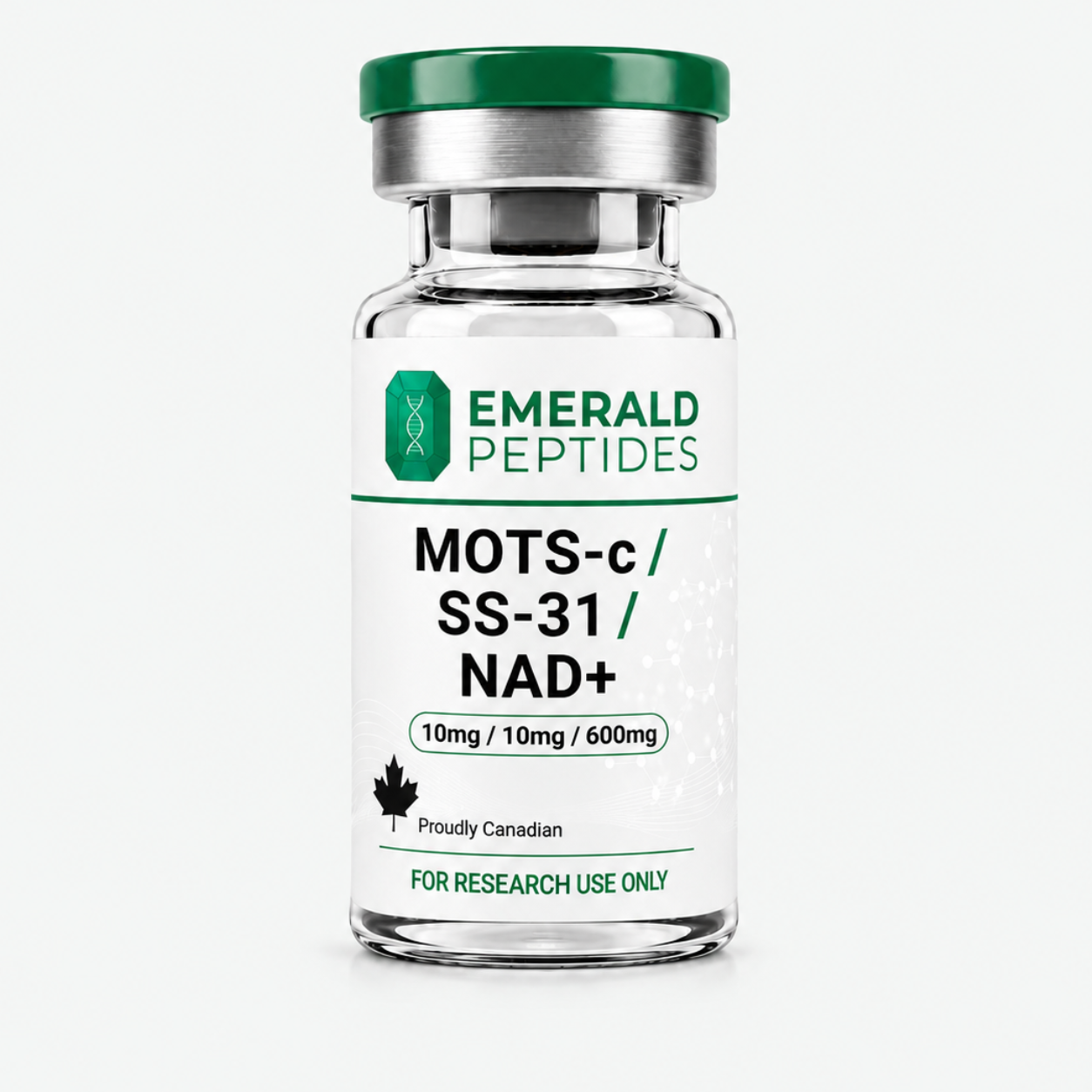
Mito Stack (MOTS-c + SS-31 + NAD+)
Mito Stack (MOTS-c + SS-31 + NAD+)
Out of stock
274 units sold
- Lab Tested for Purity & Quality
- Fast & Secure Shipping
 Manufactured in Canada


MOTS-c + SS-31 + NAD+ Stack — The Mito Stack Blend
The Mito Stack combines MOTS-c, SS-31, and NAD+ into a single matched-batch research kit for three-layer mitochondrial bioenergetics research designs. This MOTS-c SS-31 NAD+ stack addresses mitochondrial biology at three distinct levels — MOTS-c provides signaling-layer intervention through AMPK activation, SS-31 provides structural-layer intervention through cardiolipin binding and cristae stabilization, and NAD+ provides biochemical-layer intervention as the cofactor underlying sirtuin signaling and electron transport chain operation. All three compounds in the stack ship at ≥99% HPLC purity with mass-spec-verified identity, separate batch-specific certificates of analysis, and fast domestic Canadian shipping.
Product Details
- Form: Three lyophilized compounds, supplied as a kit
- Net per kit: 10 mg MOTS-c + 10 mg SS-31 + 600 mg NAD+ (each filled to approximately 104% of label)
- Purity: ≥99% (HPLC-verified, all components)
- Identity: MS-verified per COA (all components)
- Storage: 2–8 °C, protect from light; long-term NAD+ storage at −20 °C
- Components: See individual product pages for full sequence, formula, MW, and CAS data
What Makes the Mito Stack a Unique Combination
The MOTS-c SS-31 NAD+ stack reflects a deliberate stratification across the three principal layers of mitochondrial biology that researchers commonly investigate. MOTS-c addresses the signaling layer — communicating bioenergetic status from mitochondria to the nucleus and activating AMPK as a master energy-sensing kinase. SS-31 addresses the structural layer — binding cardiolipin on the inner mitochondrial membrane and stabilizing cristae morphology in compromised mitochondria. NAD+ addresses the biochemical layer — cycling between oxidized and reduced forms in redox reactions and serving as a consumed substrate for sirtuins, PARPs, and CD38.
This three-layer separation gives research groups clean mechanistic resolution. Rather than three compounds with overlapping modes of action, each operates at a distinct level of mitochondrial biology, allowing experimental designs to probe signaling, structural, and cofactor contributions in the same model system. The combination matches the modern mitochondrial-research literature, where studies frequently address all three layers simultaneously to characterize bioenergetic phenotypes in aging, metabolic, and cardiac models. As a longevity peptide stack Canada-shipped from a single supply point with matched batch documentation, the Mito Stack simplifies the documentation chain for laboratories operating under quality-control protocols.
Key Benefits
- Three-Layer Mitochondrial Investigation — The combination allows research designs to address signaling (MOTS-c / AMPK), structural (SS-31 / cardiolipin), and biochemical (NAD+ / redox and sirtuin) mechanisms simultaneously, with each compound serving a distinct role in the same model system.
- Aging & Longevity Research — All three compounds connect to age-associated mitochondrial decline. MOTS-c plasma levels decline with age in published human and animal data. SS-31 has been studied in aged-rodent skeletal muscle and cardiac models. NAD+ tissue levels decline progressively with age. Combined research designs build on three independent literatures within longevity research.
- Cardiac Bioenergetics — Rodent ischemia-reperfusion models have separately characterized SS-31's effects on infarct size and mitochondrial respiration. NAD+ has been examined in heart failure and cardiometabolic models. MOTS-c has been studied for metabolic effects relevant to cardiac substrate handling. The stack supports research designs combining all three.
- Insulin Sensitivity & Metabolic Models — MOTS-c activates AMPK to improve skeletal muscle glucose uptake. SS-31 has been characterized in type 2 diabetes models for effects on oxidative stress and ER stress. NAD+ has documented effects in rodent obesity and NAFLD models. The combination addresses metabolic dysfunction from three angles.
- Reactive Oxygen Species & Redox Biology — SS-31 reduces mitochondrial ROS production via cardiolipin binding. NAD+ governs cellular redox state through NAD+/NADH cycling. MOTS-c has been characterized for effects on antioxidant pathways through AMPK-mediated transcription. Combined research designs cover redox biology across structural and biochemical layers.
Related Peptides
Researchers working with the Mito Stack often investigate it alongside:
- MOTS-c — Available as a single-compound vial for research designs requiring MOTS-c alone or at non-stack ratios.
- SS-31 — Available as a single-compound vial for research designs requiring SS-31 alone or at non-stack ratios.
- NAD+ — Available as a single-compound vial for research designs requiring NAD+ alone or at non-stack ratios.
Frequently Asked Questions
Where can researchers buy the MOTS-c SS-31 NAD+ stack in Canada with verified purity?
Our Mito Stack ships to Canadian research labs and independent investigators with three batch-specific certificates of analysis — one per component — confirming ≥99% HPLC purity and mass-spec identity verification for MOTS-c, SS-31, and NAD+. Each vial is filled to approximately 104% of label as a quality margin for residual losses during reconstitution work, and orders dispatch from within Canada to avoid border-related cold-chain interruptions.
How are MOTS-c, SS-31, and NAD+ different from each other mechanistically?
MOTS-c is a 16-amino-acid mitochondria-derived peptide that activates AMPK and acts as a signaling molecule between mitochondria and the nucleus — a regulatory mechanism. SS-31 is a synthetic tetrapeptide that binds cardiolipin on the inner mitochondrial membrane to stabilize cristae structure and reduce ROS production — a structural mechanism. NAD+ is a pyridine dinucleotide coenzyme that participates in redox cycling and serves as a consumed substrate for sirtuins, PARPs, and CD38 — a biochemical mechanism. The three compounds operate at different levels of mitochondrial biology.
Why combine these three compounds in a single research kit?
The combination matches how mitochondrial-research designs are typically structured. Studies of mitochondrial dysfunction in aging, cardiac disease, metabolic syndrome, and neurodegeneration often address signaling, structural, and biochemical layers simultaneously — because dysfunction at one layer typically propagates to the others. A single kit gives research groups all three reference compounds with matched batch documentation, simplifying experimental designs that probe parallel mechanisms.
Is NAD+ a peptide?
No. NAD+ is a pyridine dinucleotide coenzyme — two nucleotides linked through their phosphate groups, not assembled from amino acids. It is included in the Mito Stack and catalogued alongside research peptides because of its central role in mitochondrial bioenergetics and its frequent appearance in research designs alongside MOTS-c and SS-31. Many suppliers serving the mitochondrial research domain carry both peptide and non-peptide compounds in this category.
⚠️ For research use only. Not intended for human or veterinary use. Not a drug, food, or supplement.