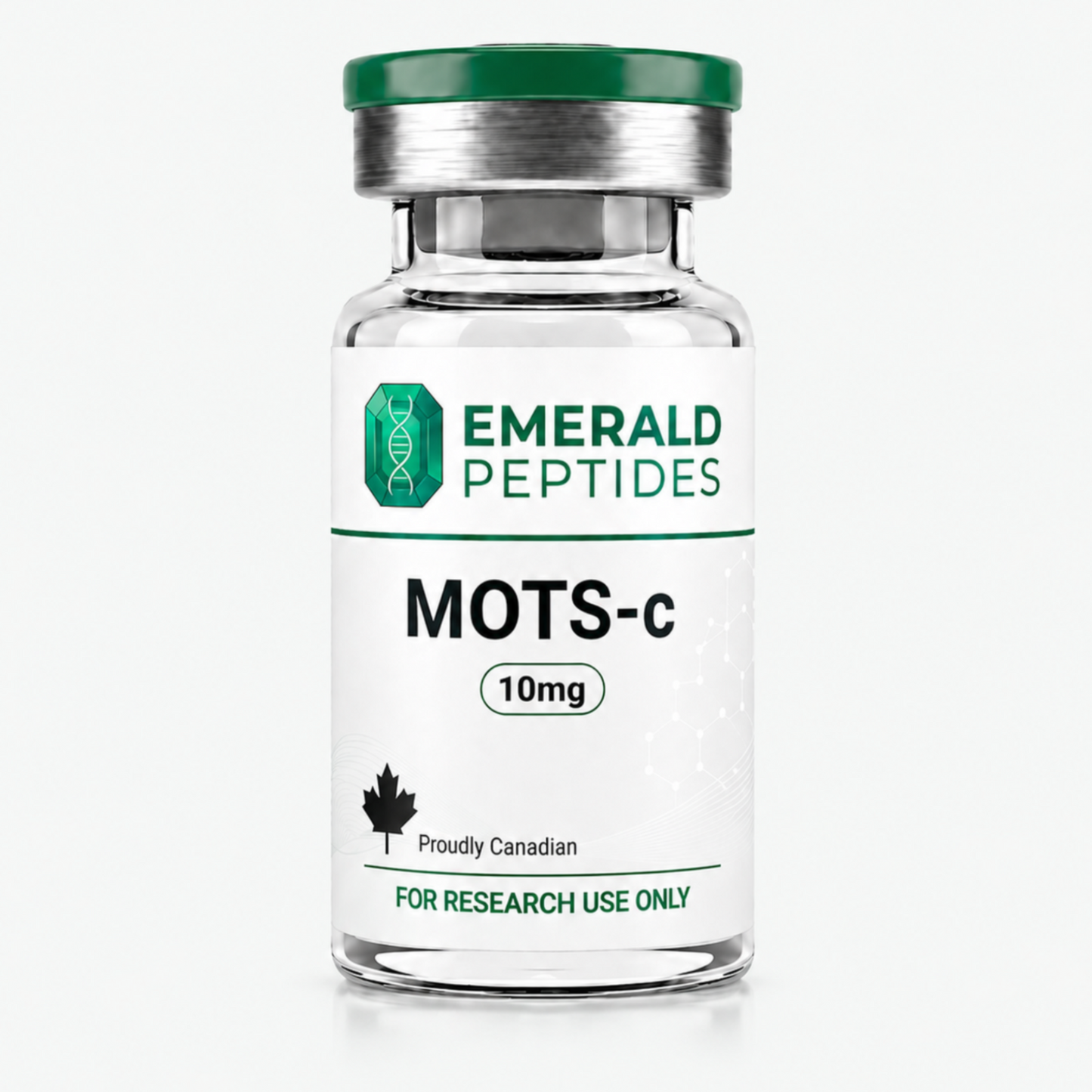
MOTS-c
MOTS-c
In stock
1132 units sold
- Lab Tested for Purity & Quality
- Fast & Secure Shipping
 Manufactured in Canada


Buy MOTS-c Canada — Mitochondrial-Derived Peptide
Buy MOTS-c in Canada as a research-grade mitochondria-derived peptide for cellular bioenergetics, AMPK signaling, and mitochondrial research designs. MOTS-c is a 16-amino-acid peptide encoded within the 12S rRNA region of mitochondrial DNA — one of only a handful of peptides known to originate from the mitochondrial genome rather than nuclear DNA. Identified in 2015 by Changhan Lee and colleagues at the USC Davis School of Gerontology, MOTS-c acts as a mitochondrial-nuclear retrograde signal that activates AMPK and shifts cellular substrate handling toward fatty acid oxidation. Each vial supplied by Emerald Peptides ships at ≥99% HPLC purity with mass-spec-verified identity, batch-specific certificate of analysis, and fast domestic Canadian shipping.
Product Details
- Form: Lyophilized peptide
- Net per vial: 10 mg (filled to approximately 104% of label)
- Purity: ≥99% (HPLC-verified)
- Identity: MS-verified (per COA)
- Storage: 2–8 °C, protect from light
- Formula / M.W.: C₁₀₁H₁₅₂N₂₈O₂₂S₂ / 2174.64 Da
- CAS: 1627580-64-6
What Makes MOTS-c a Unique Compound
MOTS-c was identified in 2015 by Changhan Lee and colleagues in the Pinchas Cohen laboratory at the USC Davis School of Gerontology, with the original characterization published in Cell Metabolism. Its discovery extended the small but growing class of mitochondrial-derived peptides — a category that began with humanin in 2001 — and challenged the long-held view that the 12S rRNA gene region produced no functional peptides.
What distinguishes MOTS-c from other research compounds is its origin. Unlike nuclear-encoded peptides translated within the cell's main protein-synthesis machinery, MOTS-c's coding sequence sits inside mitochondrial DNA, with translation occurring in the cytoplasm using the standard genetic code. The first 11 residues are highly conserved across 14 species, suggesting strong evolutionary pressure on its function. This combination — mitochondrial origin, cross-species conservation, AMPK-pathway activity — gives researchers a unique tool for probing the bioenergetic-signaling axis between mitochondria and the rest of the cell.
Key Benefits
- Insulin Sensitivity & Glucose Metabolism — Published animal studies have reported improved skeletal muscle glucose uptake and insulin sensitivity following MOTS-c administration, with mechanistic work attributing the effect to AMPK pathway activation.
- Adiposity & Body Composition — Rodent studies of high-fat-diet-induced obesity have measured reductions in body fat mass and improved metabolic parameters in MOTS-c-treated cohorts, generating sustained interest in the peptide as a research tool for metabolic-syndrome models.
- Exercise Mimetic & Endurance — MOTS-c is upregulated in response to exercise, and rodent endurance studies have reported improved running capacity and metabolic flexibility in treated animals — supporting its characterization as an endogenous exercise mimetic.
- Aging & Longevity — Plasma MOTS-c levels decline with age in published human and animal data, and mid-life administration in mouse models has been examined for effects on healthspan markers, drawing interest from longevity research groups.
- Mitochondrial Bioenergetics — As a mitochondrial-nuclear retrograde signal, MOTS-c serves as a research handle on inter-organelle communication, with studies measuring effects on substrate oxidation, mitochondrial biogenesis markers, and bioenergetic flexibility.
Related Peptides
Researchers working with MOTS-c often investigate it alongside:
- SS-31 — Tetrapeptide that targets cardiolipin on the inner mitochondrial membrane; complements MOTS-c's signaling activity with a structural mitochondrial-stabilization mechanism, and pairs with both compounds in our Mito Stack (see below).
- NAD+ — Mitochondrial cofactor central to sirtuin signaling and redox balance; the third compound in the Mito Stack and a frequent companion in bioenergetics research designs.
- Mito Stack — Combined MOTS-c + SS-31 + NAD+ research blend for groups studying mitochondrial function across signaling, structural, and cofactor mechanisms in parallel.
Frequently Asked Questions
Where can researchers buy MOTS-c in Canada with verified purity documentation?
Our MOTS-c ships to Canadian research labs and independent investigators with a batch-specific certificate of analysis confirming ≥99% HPLC purity and mass-spec identity verification. Vials are filled to approximately 104% of the labeled 10 mg as a quality margin for residual losses during reconstitution work, and ship from within Canada to avoid border-related cold-chain interruptions.
How is MOTS-c different from SS-31?
Both are mitochondrial-focused peptides but engage entirely different mechanisms. MOTS-c is a 16-amino-acid signaling peptide encoded within mitochondrial DNA; it activates AMPK and acts as a mitochondrial-nuclear retrograde messenger. SS-31 (elamipretide) is a synthetic tetrapeptide that binds cardiolipin on the inner mitochondrial membrane to stabilize cristae structure and reduce reactive oxygen species production. Many research designs use them together to address mitochondrial function from both signaling and structural angles.
Is MOTS-c naturally occurring?
Yes. MOTS-c is endogenous in humans and most mammals, encoded by the MT-RNR1 gene within the mitochondrial 12S rRNA region. It is detectable in plasma in both rodents and humans, with levels that decline with age. The synthetic peptide sold for research is sequence-identical to the endogenous form.
What is the evidence base for MOTS-c?
Since the original 2015 Cell Metabolism characterization, the published literature has expanded to cover insulin sensitivity, body composition, exercise capacity, aging biomarkers, and inflammatory and host-defense functions. Animal model data are well-developed across rodent systems. Human clinical data remain limited, with most evidence drawn from preclinical work and observational studies of endogenous MOTS-c levels.
⚠️ For research use only. Not intended for human or veterinary use. Not a drug, food, or supplement.