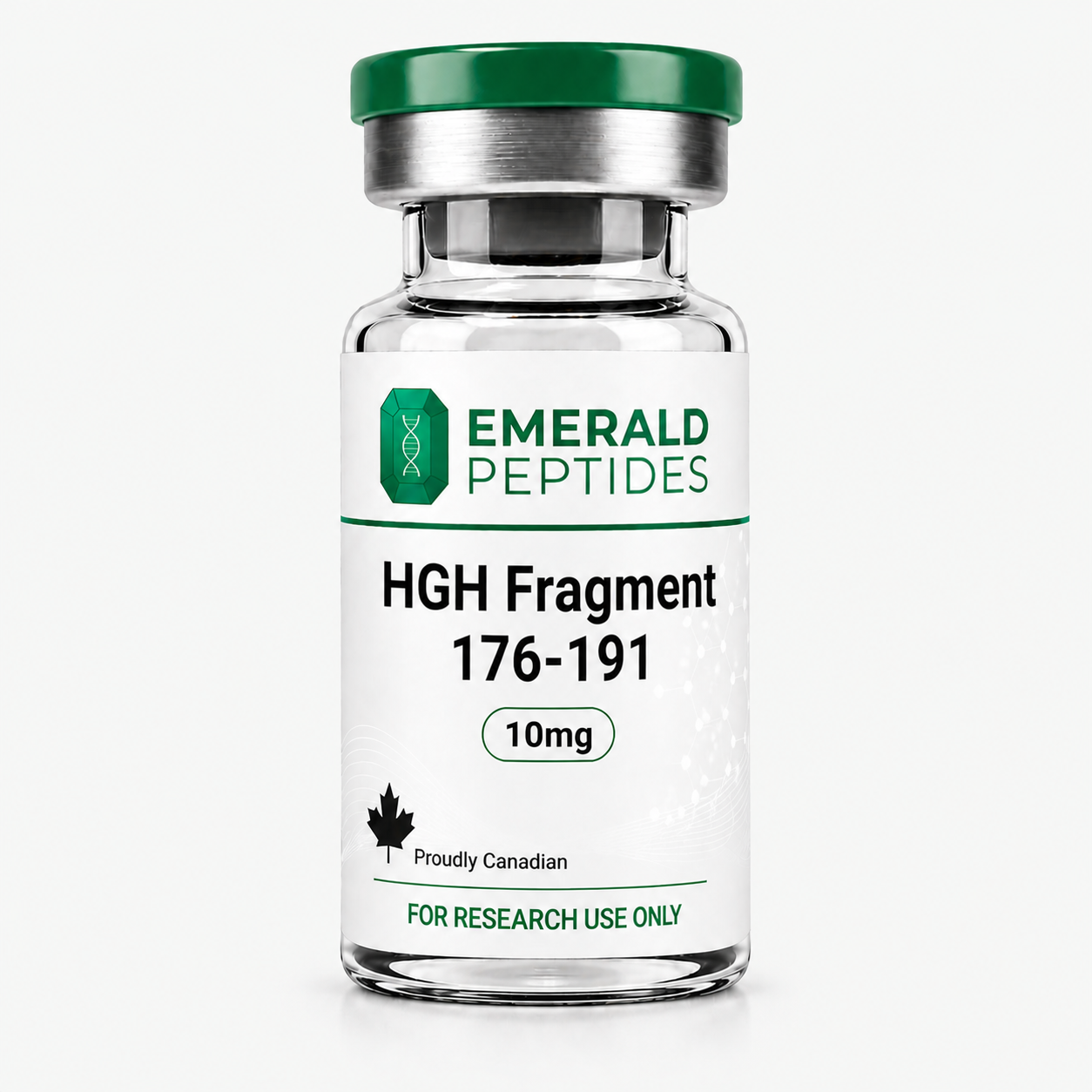
HGH Fragment (176-191)
HGH Fragment (176-191)
In stock
517 units sold
- Lab Tested for Purity & Quality
- Fast & Secure Shipping
 Manufactured in Canada


Buy HGH Fragment 176-191 Canada — Lipolytic hGH Peptide
Buy HGH Fragment 176-191 in Canada as a research-grade lipolytic peptide fragment for adipose tissue research designs decoupled from the GH/IGF-1 axis. HGH Fragment 176-191 corresponds to the C-terminal 16 amino acids of human growth hormone — the region that retains lipolytic activity but lacks the residues required for IGF-1 stimulation. Developed in the late 1990s by Frank Ng and colleagues at Monash University, the compound was subsequently advanced through Phase 2 clinical trials in obesity research under the development code AOD-9604. Each vial supplied by Emerald Peptides ships at ≥99% HPLC purity with mass-spec-verified identity, batch-specific certificate of analysis, and fast domestic Canadian shipping.
Product Details
- Form: Lyophilized peptide
- Net per vial: 10 mg (filled to approximately 104% of label)
- Purity: ≥99% (HPLC-verified)
- Identity: MS-verified (per COA)
- Storage: 2–8 °C, protect from light
- Formula / M.W.: C₇₈H₁₂₅N₂₃O₂₃S₂ / 1817.12 Da
- CAS: 221231-10-3
What Makes HGH Fragment 176-191 a Unique Compound
HGH Fragment 176-191 was developed in the late 1990s by Frank Ng and colleagues at Monash University, Australia, as part of a structure-activity program designed to isolate the lipolytic domain of human growth hormone from its broader endocrine activity. The compound was subsequently licensed to Metabolic Pharmaceuticals — later Calzada — and advanced through Phase 2 clinical trials in obesity in the early 2000s under the development code AOD-9604.
What distinguishes the fragment in research is its mechanistic specificity. Full-length hGH binds the GH receptor and triggers the complete cascade — IGF-1 elevation, growth signaling, glucose handling, and lipolysis. By using only the C-terminal 16 residues, HGH Fragment 176-191 retains lipolytic activity without engaging the GH receptor in the IGF-1-stimulating mode. That decoupling gives Canadian research groups a clean tool for studying adipose-specific hGH actions in isolation from the systemic GH/IGF-1 axis effects that confound full-hGH study designs.
Key Benefits
- Lipolysis & Fatty Acid Mobilization — Published preclinical studies have characterized HGH Fragment 176-191's activation of hormone-sensitive lipase and stimulation of fatty acid release from adipose tissue, with effects observed in both subcutaneous and visceral adipocyte models.
- Anti-Lipogenic Activity — Animal studies have measured reductions in fatty acid synthesis alongside increased lipolysis, generating sustained interest in the fragment as a research tool for adipose-specific dual-mechanism investigation.
- Body Composition Models — Rodent obesity models have reported reductions in fat mass without proportional changes in lean mass following HGH Fragment 176-191 administration, with mechanistic work attributing the selectivity to the absence of GH-receptor-mediated growth signaling.
- Decoupled Metabolic Research — Unlike full hGH, the fragment does not substantially elevate IGF-1 or alter glucose homeostasis in published animal models, making it a useful tool for research designs requiring lipolysis activity without confounding GH/IGF-1 axis effects.
- Cartilage & Joint Research — A subset of preclinical work has examined HGH Fragment 176-191 in osteoarthritis and cartilage degradation models, characterizing effects on chondrocyte signaling that are mechanistically distinct from its primary lipolytic profile.
Related Peptides
Researchers working with HGH Fragment 176-191 often investigate it alongside:
- Tesamorelin — GHRH analog that stimulates pituitary GH release and triggers the full GH/IGF-1 cascade; the standard mechanistic contrast for research designs comparing isolated lipolytic activity against full-axis activation.
- Retatrutide (GLP-3) — Triple GLP-1/GIP/glucagon agonist with documented adiposity-research data; provides a receptor-level metabolic-pathway contrast to HGH Fragment 176-191's adipocyte-direct lipolytic mechanism.
- MOTS-c — Mitochondria-derived peptide that activates AMPK; complements HGH Fragment 176-191's lipolytic profile with a cellular-energetics angle on metabolic research.
Frequently Asked Questions
Where can researchers buy HGH Fragment 176-191 in Canada with verified purity?
Our HGH Fragment 176-191 ships to Canadian research labs and independent investigators with a batch-specific certificate of analysis confirming ≥99% HPLC purity and mass-spec identity verification. Vials are filled to approximately 104% of the labeled 10 mg as a quality margin for residual losses during reconstitution work, and ship from within Canada to avoid border-related cold-chain interruptions.
How is HGH Fragment 176-191 different from Tesamorelin or full hGH?
The three operate at different points in the GH axis. Full hGH binds the GH receptor and triggers the complete cascade — IGF-1 production, growth signaling, glucose modulation, and lipolysis. Tesamorelin is a GHRH analog that stimulates pituitary GH release, indirectly producing the full hGH cascade. HGH Fragment 176-191 isolates only the C-terminal lipolytic region of hGH, retaining fat-mobilization activity without engaging the GH receptor in the IGF-1-stimulating mode. Research designs select among the three based on whether full-axis activation, indirect GH stimulation, or isolated lipolysis is the relevant mechanism.
Is HGH Fragment 176-191 the same as AOD-9604?
The two are closely related and frequently treated as synonymous in research peptide markets. HGH Fragment 176-191 refers to the synthetic 16-amino-acid sequence corresponding to residues 176-191 of human growth hormone. AOD-9604 is the same fragment as developed by Metabolic Pharmaceuticals and tested in Phase 2 clinical trials in obesity. Most research suppliers use the names interchangeably, and the published preclinical literature largely treats them as equivalent compounds.
Is HGH Fragment 176-191 naturally occurring?
Partially. The 16-amino-acid sequence corresponds exactly to residues 176-191 of native human growth hormone, an endogenous peptide hormone produced by the anterior pituitary. The fragment itself does not occur freely in nature — it is a synthetic peptide isolated from the parent hGH sequence to study the lipolytic activity of that specific region. The synthetic peptide sold for research is sequence-identical to the corresponding region of native hGH.
⚠️ For research use only. Not intended for human or veterinary use. Not a drug, food, or supplement.